

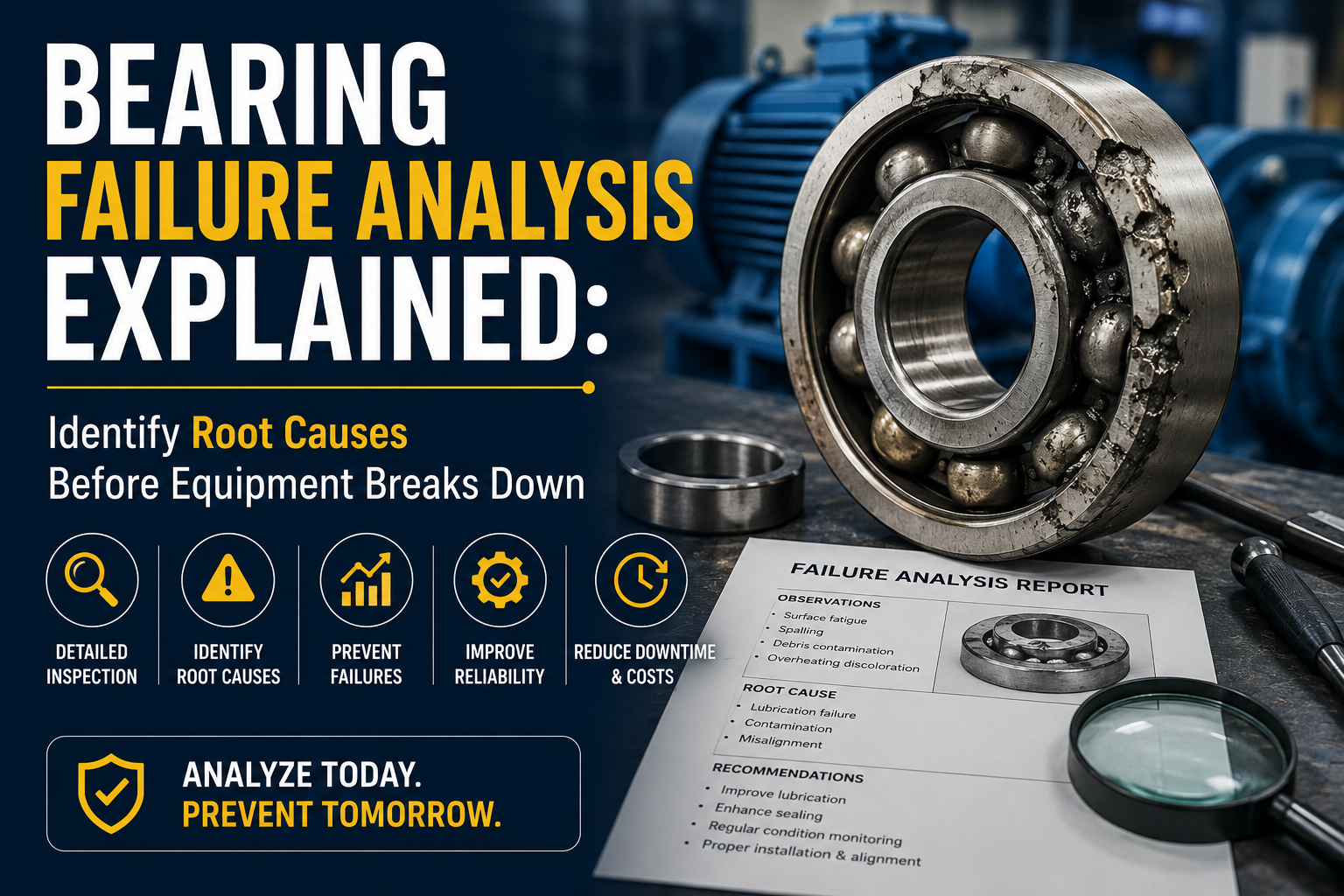
Bearing Failure Analysis Explained: Identify Root Causes Before Equipment Breaks Down

Modern industries depend on rotating equipment to keep production running smoothly. From manufacturing plants and power stations to mining operations and oil refineries, bearings play a vital role in ensuring machinery performs efficiently. However, when a bearing fails unexpectedly, the consequences can be severe, including costly downtime, expensive repairs, reduced productivity, and safety risks.
This is why bearing failure analysis has become an essential practice for maintenance professionals, reliability engineers, and asset managers. Rather than simply replacing a failed bearing, organizations now focus on identifying the underlying causes of failure to prevent similar incidents in the future.
In this comprehensive guide, you'll learn everything you need to know about bearing failure analysis, understand common causes of bearing damage, explore effective inspection methods, and discover why bearing failure analysis training is one of the smartest investments for maintenance teams.
What Is Bearing Failure Analysis?
Bearing failure analysis is the systematic investigation of damaged or failed bearings to determine why they failed. Instead of assuming a bearing simply wore out, engineers examine physical evidence, operating conditions, lubrication practices, contamination levels, installation methods, and machine alignment. The objective is straightforward:
-
Identify the root cause
-
Prevent repeated failures
-
Improve equipment reliability
-
Reduce maintenance costs
-
Extend machine lifespan
A bearing is rarely the actual problem. More often, it becomes the victim of another issue occurring elsewhere within the machine.
Why Bearing Failure Analysis Matters
Unexpected bearing failures create ripple effects throughout an organization. These include:
-
Production downtime
-
Emergency maintenance expenses
-
Lost product output
-
Increased spare parts consumption
-
Safety hazards
-
Reduced customer satisfaction
Conducting proper bearing damage analysis enables maintenance teams to solve problems permanently rather than repeatedly replacing failed components. Organizations that adopt root cause analysis often experience:
-
Longer bearing life
-
Lower maintenance costs
-
Improved equipment availability
-
Better reliability metrics
-
Reduced inventory requirements
Understanding the Lifecycle of a Bearing
Bearings are engineered to last for thousands or even millions of operating cycles. However, very few bearings actually reach their theoretical lifespan. The typical lifecycle includes:
Installation
Correct mounting techniques are essential. Poor installation introduces stress before the machine even starts.
Normal Operation
During normal operation, bearings experience:
-
Rotational loads
-
Heat
-
Lubrication cycles
-
Vibration
-
Speed variations
Damage Development
Small defects begin forming due to contamination, lubrication issues, overload, or misalignment.
Progressive Failure
Minor defects gradually become larger cracks, spalls, or fractures.
Catastrophic Failure
Eventually the bearing becomes unusable, causing equipment shutdown. Bearing failure analysis focuses on identifying where this progression began.
Most Common Causes of Bearing Failure
Understanding why bearings fail is the first step toward preventing future failures.
1. Poor Lubrication
Industry studies consistently identify lubrication problems as the leading cause of bearing failures. Common lubrication issues include:
-
Insufficient grease
-
Wrong lubricant viscosity
-
Grease contamination
-
Over-greasing
-
Oil degradation
Without proper lubrication, metal surfaces contact each other directly, causing excessive friction and heat. Signs include:
-
Blue discoloration
-
Scoring
-
Surface wear
-
Overheating
2. Contamination
Dust, dirt, water, chemicals, and metal particles significantly reduce bearing life. Even microscopic contaminants can damage rolling elements. Common contamination sources include:
-
Damaged seals
-
Dirty lubricants
-
Poor maintenance practices
-
Moisture ingress
Contamination often causes:
-
Abrasive wear
-
Surface scratching
-
Corrosion
-
Premature fatigue
3. Misalignment
When shafts are misaligned, bearings experience uneven loading. Misalignment creates:
-
Edge loading
-
Excessive vibration
-
Heat generation
-
Increased friction
Proper shaft alignment greatly extends bearing life.
4. Improper Installation
Many bearing failures originate during installation. Common mistakes include:
-
Hammering bearings
-
Incorrect mounting tools
-
Applying force to the wrong race
-
Improper fits
-
Shaft damage
Correct installation procedures help eliminate early failures.
5. Electrical Damage
Electric motors sometimes generate stray electrical currents. These currents pass through bearings, creating:
-
Fluting
-
Pitting
-
Frosting
-
Electrical erosion
Proper grounding and insulated bearings help prevent electrical damage.
6. Overloading
Every bearing has a designed load capacity. Excessive loads accelerate:
-
Fatigue
-
Cracking
-
Cage failure
-
Rolling element damage
Equipment modifications should always include bearing load calculations.
7. Fatigue Failure
Eventually, repeated stress causes microscopic cracks. These cracks expand over time until sections of the raceway begin flaking. Fatigue failures usually appear as:
-
Spalling
-
Surface pitting
-
Material loss
Unlike premature failures, fatigue often indicates the bearing reached its intended service life.
Recognizing Different Types of Bearing Damage
Effective bearing damage analysis depends on recognizing visual damage patterns.
Surface Wear
Caused by:
-
Poor lubrication
-
Contamination
-
Excessive sliding
Symptoms include polished or worn raceways.
Corrosion
Moisture causes rust formation. Corrosion weakens bearing surfaces and accelerates fatigue.
Brinelling
Brinelling creates permanent indentations. It occurs due to:
-
Heavy impacts
-
Improper handling
-
Static overload
False Brinelling
Unlike true brinelling, false brinelling results from vibration while equipment remains stationary. Common during transportation or idle storage.
Smearing
Smearing occurs when rolling elements slide rather than roll. This generates:
-
High temperatures
-
Material transfer
-
Rough surfaces
Cage Failure
Bearing cages maintain proper spacing between rolling elements.
Failure causes include:
-
High speed
-
Poor lubrication
-
Excessive vibration
-
Contamination
Steps in an Effective Bearing Failure Analysis Process
Successful investigations follow a structured methodology.
Step 1: Gather Background Information
Collect information including:
-
Operating hours
-
Load conditions
-
Lubrication schedule
-
Maintenance history
-
Environmental conditions
Step 2: Inspect the Failed Bearing
Visual examination identifies:
-
Wear patterns
-
Corrosion
-
Cracks
-
Surface damage
-
Heat discoloration
High-resolution photographs should document all observations.
Step 3: Analyze Lubrication
Evaluate:
-
Grease quality
-
Oil contamination
-
Water content
-
Particle analysis
Lubricant analysis often reveals hidden equipment problems.
Step 4: Examine Adjacent Components
The bearing may not be the root cause. Inspect:
-
Shafts
-
Housings
-
Seals
-
Couplings
-
Gearboxes
Step 5: Review Operating Conditions
Consider:
-
Temperature
-
Speed
-
Vibration
-
Load
-
Alignment
Historical condition monitoring data provides valuable insights.
Step 6: Determine Root Cause
After collecting evidence, identify the primary cause not just the visible damage. This distinction separates effective bearing failure analysis from simple inspection.
Tools Used in Bearing Failure Analysis
Modern maintenance teams use advanced diagnostic technologies. These include:
Vibration Analysis
Detects:
-
Imbalance
-
Misalignment
-
Bearing defects
-
Looseness
Thermography
Infrared cameras identify overheating components before failure.
Oil Analysis
Examines:
-
Wear metals
-
Contaminants
-
Lubricant condition
Ultrasound Testing
Identifies:
-
Lubrication deficiencies
-
Early bearing defects
-
Friction increases
Microscopic Inspection
High-magnification analysis reveals:
-
Fatigue cracks
-
Surface wear
-
Contamination damage
Together, these tools improve the accuracy of bearing damage analysis and support predictive maintenance strategies.
How Predictive Maintenance Supports Bearing Reliability
Traditional maintenance often relies on scheduled inspections or reactive repairs. Predictive maintenance shifts the focus to monitoring equipment condition in real time, allowing maintenance teams to detect bearing issues before failure occurs.
Technologies such as vibration monitoring, temperature sensing, oil analysis, and ultrasonic testing provide valuable data that helps identify abnormal operating conditions. Instead of replacing bearings based on estimated service life, organizations can make informed maintenance decisions based on actual equipment health. Benefits of predictive maintenance include:
-
Reduced unplanned downtime
-
Longer bearing service life
-
Lower maintenance costs
-
Improved equipment reliability
-
Better resource planning
When predictive maintenance is combined with bearing failure analysis, companies can continuously improve maintenance strategies and prevent recurring issues.
Best Practices for Preventing Bearing Failures
Preventing failures is always more cost-effective than repairing damaged equipment. Organizations can significantly improve bearing performance by adopting the following best practices:
-
Select the correct bearing for the application.
-
Follow manufacturer installation guidelines.
-
Use the proper lubrication type and quantity.
-
Keep bearings and lubricants free from contamination.
-
Monitor vibration and operating temperatures regularly.
-
Perform routine alignment checks.
-
Replace damaged seals promptly.
-
Train maintenance personnel in inspection and diagnostic techniques.
-
Maintain detailed maintenance records.
-
Conduct regular root cause investigations after every failure.
These proactive measures reduce the likelihood of unexpected breakdowns and improve overall equipment efficiency.
The Importance of Bearing Failure Analysis Training
Even experienced maintenance professionals benefit from specialized bearing failure analysis training.
Training helps teams:
-
Identify damage patterns accurately
-
Perform structured investigations
-
Understand lubrication principles
-
Interpret vibration data
-
Prevent recurring failures
-
Improve maintenance planning
-
Increase equipment availability
Rather than relying on guesswork, trained professionals make evidence-based maintenance decisions that reduce costs and improve reliability. Organizations that invest in training often see measurable improvements in asset performance, maintenance efficiency, and operational uptime.
Enhance Your Skills with GI Intelligence's Bearing Failure Analysis Training
If you're looking to strengthen your maintenance capabilities, GI Intelligence offers a comprehensive Bearing Failure Analysis Training program designed for maintenance engineers, reliability professionals, technicians, supervisors, and asset management teams.
The course provides practical knowledge on identifying common bearing failure modes, conducting effective bearing damage analysis, interpreting failure patterns, understanding lubrication best practices, and applying proven root cause analysis techniques to prevent recurring equipment issues. Participants gain valuable insights through real-world examples and industry-focused instruction, enabling them to make informed maintenance decisions that improve equipment reliability and reduce downtime.
Whether you're building a preventive maintenance program or enhancing an existing reliability strategy, GI Intelligence's training equips your team with the expertise needed to maximize bearing performance and extend machinery life.
Conclusion
Bearing failures are rarely random events. They are usually the result of underlying issues such as poor lubrication, contamination, improper installation, misalignment, electrical damage, or excessive loading. By implementing a structured bearing failure analysis process, maintenance teams can identify these root causes before they lead to repeated equipment breakdowns.
Comprehensive bearing damage analysis not only extends bearing life but also improves machine reliability, minimizes unplanned downtime, reduces maintenance costs, and enhances overall operational performance. When combined with predictive maintenance technologies and continuous improvement practices, bearing analysis becomes a powerful tool for achieving long-term asset reliability.
Finally, investing in bearing failure analysis training ensures maintenance professionals have the skills needed to accurately diagnose failures, implement corrective actions, and prevent recurring issues. Organizations that prioritize knowledge, data-driven maintenance, and continuous learning position themselves for greater efficiency, higher productivity, and sustained operational success.


