

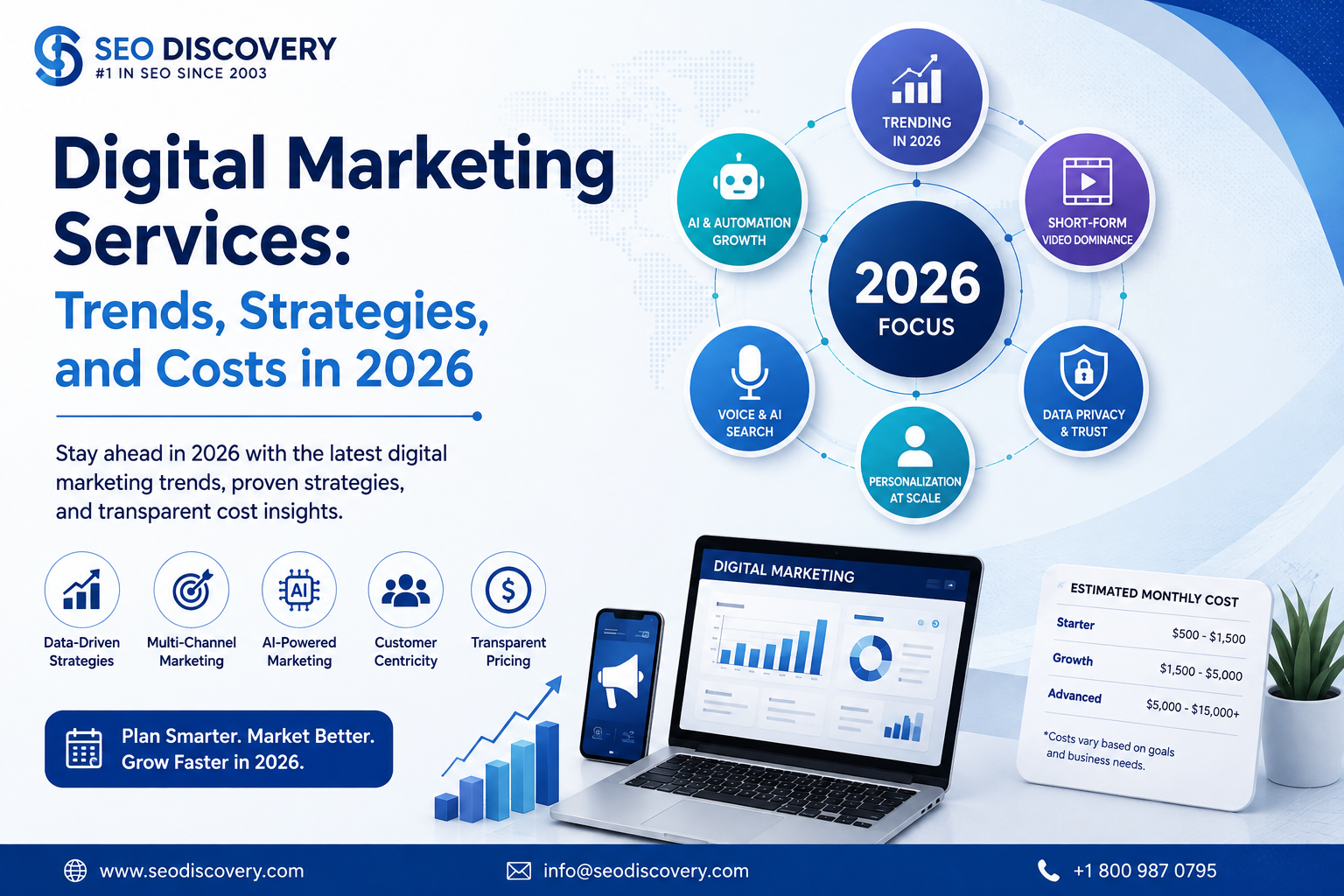
Digital Marketing Services: Trends, Strategies, and Costs in 2026

Digital marketing services in 2026 look nothing like they did even two years ago. AI has moved from a content-writing shortcut to the operating layer behind planning, targeting, and measurement, while search itself has split into two parallel tracks: traditional ranked results and AI-generated answers from tools like ChatGPT, Gemini, and Perplexity. For any business evaluating a digital marketing agency this year, the question is no longer just "can you rank us on Google" but "can you get us found, trusted, and cited everywhere people are actually searching." This guide breaks down what modern digital marketing services actually include, the strategies driving results in 2026, and what you should realistically expect to pay.
What Digital Marketing Services Cover in 2026
A digital marketing service provider today typically bundles several disciplines under one roof rather than selling them piecemeal. The core services businesses ask for most often include:
-
Search Engine Optimization (SEO) and its newer counterpart, Generative Engine Optimization (GEO), which optimizes content to be cited inside AI answers, not just ranked in blue links
-
Pay-per-click (PPC) advertising across Google, Microsoft Ads, and paid social
-
Social media marketing, including short-form video and community management
-
Content marketing, from blog production to email nurture sequences
-
Web design and conversion rate optimization (CRO)
-
Online reputation management and local SEO for multi-location businesses
The businesses getting the best results in 2026 are not picking one channel in isolation. They are working with a digital marketing agency that treats SEO, paid media, content, and AI visibility as one connected system, because search engines and AI answer engines increasingly draw on the same underlying signals of quality and trust.
The Trends Actually Shaping 2026
1. AI Is Now the Strategic Layer, Not Just a Tool
Artificial intelligence has moved from generating content variations to actively guiding campaign strategy, audience targeting, and real-time optimization. Marketing teams are shifting from executing tasks by hand to interpreting AI-driven insights and directing the systems that produce them. For agencies, this means the value they offer clients increasingly comes from knowing how to steer these tools, not simply operate them.
2. Generative Engine Optimization (GEO) Has Become Non-Negotiable
Answer engines like ChatGPT, Gemini, Perplexity, and Google's AI Overviews synthesize responses from multiple sources instead of just listing links. To be cited, content needs to state the direct answer in the first few sentences, be broken into self-contained, extractable sections, and carry clear structured data. Businesses that only optimize for classic SERP rankings are increasingly invisible in this second, fast-growing channel. Any competent digital marketing company in USA or elsewhere should now be building content with both tracks in mind.
3. Personalization at Scale
Consumers respond strongly to brands that tailor content to their behavior and preferences, and a large majority say they are more likely to buy from brands that personalize their experience. AI-powered segmentation now makes this achievable for mid-sized businesses, not just enterprise brands with massive data teams.
4. Video, Interactive Content, and Shoppable Formats
Short-form and shoppable video continue to dominate engagement, with viewers able to purchase directly from embedded links inside the content. Interactive formats, quizzes, calculators, and immersive product previews are pulling attention away from static posts because they keep users engaged longer and generate first-party data agencies can act on.
5. Trust and Authenticity as Ranking Signals
As AI-generated content floods the internet, both search engines and AI systems are placing more weight on demonstrated experience, named authorship, and independently verifiable claims, mirroring the E-E-A-T principles search evaluators have used for years. Thin, unoriginal content is being filtered out of both classic rankings and AI citations at a faster rate than before.
6. Agentic AI and Marketing Mix Modeling
Autonomous AI systems capable of executing multi-step campaign workflows, adjusting bids, testing creative, and reallocating budget without constant human input are moving from experimental to mainstream. At the same time, the fragmentation of ad channels is pushing more businesses toward marketing mix modeling to understand which touchpoints actually drive conversions across a longer, messier customer journey.
Strategies That Work for Digital Marketing Services Right Now
Build for dual-track visibility. Every piece of content should answer the user's core question directly within the first few lines, use clear subheadings that could stand alone as extracted passages, and include structured data (FAQ, HowTo, Article schema) so both search crawlers and AI retrieval systems can parse it accurately.
Treat SEO and AI answer optimization as one discipline. A page can rank well in classic search while being invisible in AI answers, or vice versa. The fix for the first case is adding direct-answer summaries and FAQ blocks; the fix for the second is standard technical and authority-building SEO work. Auditing content against both tracks, rather than SEO alone, is quickly becoming standard practice for any serious internet marketing services provider.
Invest in original data and expertise. AI systems disproportionately favor content with genuinely original research, real numbers, and named expertise over generic summaries, because that's what differentiates a primary source from a rehash.
Localize and verify geographic targeting. For businesses in the USA working with an offshore or global agency, confirming correct international targeting, hreflang tags, and U.S.-based sourcing on regulatory or financial topics protects visibility in both American search results and AI answers.
Diversify channel mix deliberately. Relying on a single channel is riskier in 2026 than it has ever been. A blended strategy across SEO, PPC, social, and content spreads risk and captures users at different stages of an increasingly non-linear buying journey.
How Much Do Digital Marketing Services Cost in 2026?
Pricing varies widely depending on scope, agency size, and location, but a few consistent bands have emerged across industry pricing data this year:
|
Business Size |
Typical Monthly Range |
What It Usually Covers |
|
Small business / startup |
$350– $500 |
One or two channels, e.g. local SEO plus social media |
|
Small to mid-size business |
$350 – $700 |
Multi-channel campaigns: SEO, PPC, content, social |
|
Established mid-market |
$500 – $1000 |
Full-funnel strategy with dedicated strategists |
|
Enterprise / SaaS |
$1,000 – $5000+ |
Advanced analytics, demand generation, multi-market campaigns |
Hourly consulting and audit work typically runs $75 to $400 an hour depending on the provider's experience level and location, and most agencies still quote custom pricing rather than publishing flat rates, since scope and channel mix change the number so significantly. Ad spend is almost always billed separately from management fees, so budgeting should account for both.
The widest driver of cost is service complexity. Running a single Google Ads account for one location is a fundamentally different job than orchestrating SEO, PPC, social, email, and AI-visibility optimization across multiple markets, and pricing scales accordingly. A boutique digital marketing agency may charge $1,500 a month for SEO while an enterprise firm charges ten times that for a comparable scope, with the difference usually reflecting overhead and client size expectations rather than a proportional jump in quality.
Choosing the Right Digital Marketing Service Provider
When comparing a digital marketing agency, digital marketing service provider, or internet marketing services firm, look past the price sheet and check for:
-
Case studies with verifiable, named clients and measurable outcomes
-
A content process built around both classic SEO and GEO/AEO, not SEO alone
-
Transparent reporting tied to revenue or leads, not just traffic or impressions
-
Experience in your specific vertical or business size, since a generalist agency built for enterprise SaaS rarely fits a local service business well
-
Clear communication about what is included in the retainer versus billed as an add-on
Businesses that treat this evaluation seriously tend to avoid the two most common failure modes: overpaying a large agency for junior-level execution, or underpaying a low-cost provider that cuts corners on content quality and strategic oversight.
Final Thoughts
Digital marketing in 2026 rewards businesses that stop thinking in channels and start thinking in systems. AI has changed how people search, how content gets found, and how trust gets established online, and the digital marketing services that win this year are the ones built around that shift rather than around last decade's playbook. Whether you are comparing a boutique digital marketing agency, a full-service digital marketing company in USA, or a global provider, the fundamentals stay the same: original expertise, structured and direct content, transparent pricing, and a strategy that covers both search engines and AI answer engines. Agencies like SEO Discovery build campaigns around exactly this dual-track approach, combining classic SEO with AI search optimization so clients stay visible as the search landscape keeps splitting in two.
If you're ready to see where your current strategy stands against these 2026 benchmarks, reach out to SEO Discovery's team for a free audit and a clear breakdown of what it would take to get your brand found, trusted, and cited across both search and AI.
For businesses evaluating internet marketing services this year, the real advantage goes to teams that pair deep channel expertise with the willingness to adapt as fast as the technology does, and SEO Discovery has spent over two decades doing exactly that for clients across 50+ countries.


