
What Happens to Your CIBIL Score When You Apply for a Loan? Hard vs Soft Enquiry Explained

When you apply for a loan, the lender may check your CIBIL Report to assess your credit history and repayment behaviour. This creates a record known as a loan application CIBIL enquiry.
Many borrowers worry that every credit check will significantly reduce their CIBIL Score. However, the impact depends on the type of enquiry and how frequently you apply for credit.
Understanding hard enquiry vs soft enquiry can help you manage your credit profile and avoid unnecessary loan applications.
What Is a Loan Application CIBIL Enquiry?
A loan application CIBIL enquiry occurs when a bank or financial institution accesses your CIBIL Report while processing a loan or credit application.
According to TransUnion CIBIL, every time a lender checks your CIBIL Score and Report for a loan or credit-card application, an enquiry can be recorded in the Enquiries section of your report.
The enquiry itself is not a loan account. It simply records that a lender requested your credit information.
Your CIBIL Report can show details such as:
-
Lender name
-
Date of enquiry
-
Type or purpose of credit
-
Enquiry reference information
CIBIL says enquiries from lenders are listed for the last 36 months in the report.
What Is a Hard Enquiry?
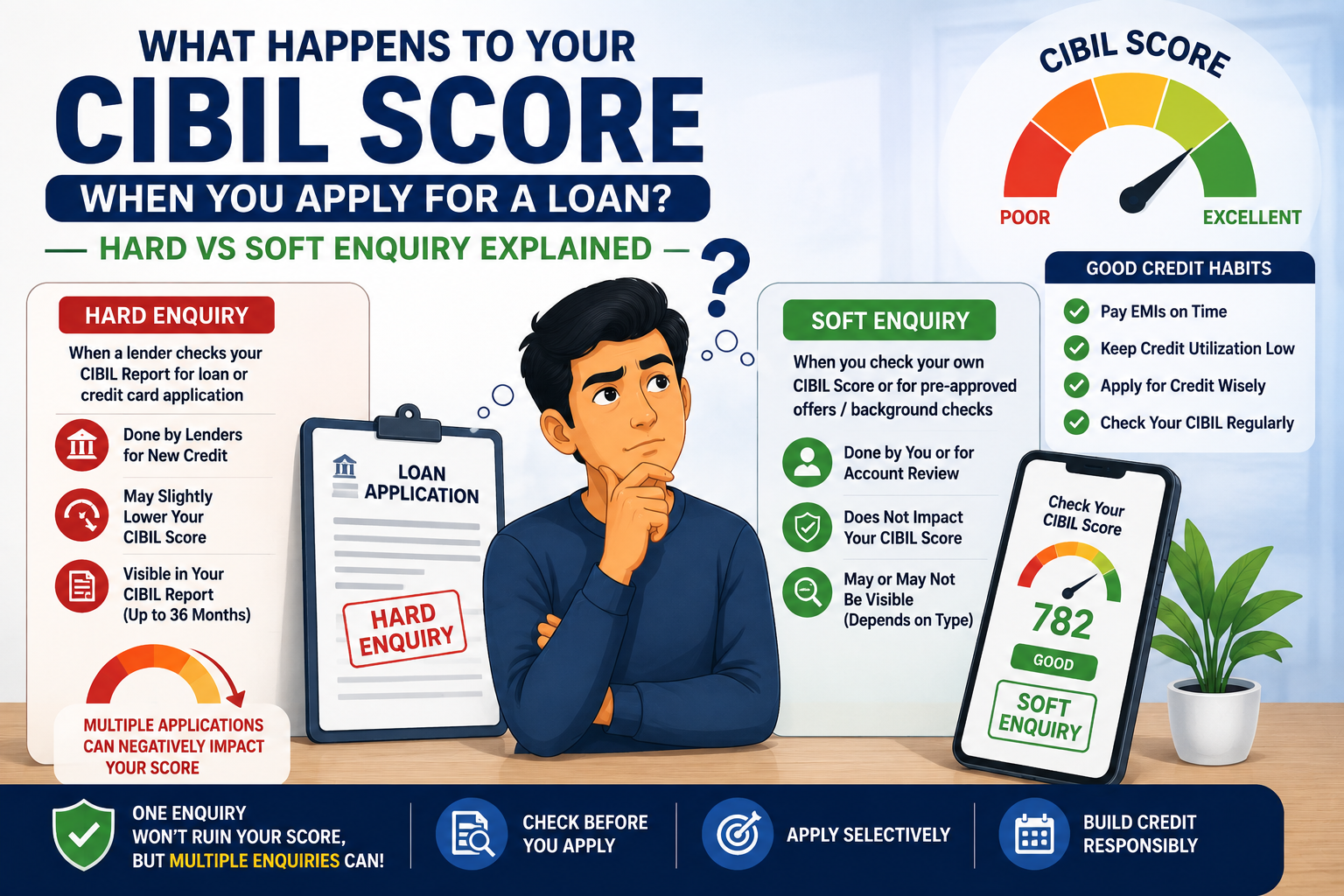
A hard enquiry generally occurs when a lender checks your credit report as part of your application for new credit.
Examples include applying for:
-
Personal loan
-
Home loan
-
Car loan
-
Credit card
-
Other forms of credit
A lender typically performs a hard enquiry to assess your creditworthiness when you apply for credit. CIBIL states that frequent hard enquiries over a short period may negatively affect your CIBIL Score.
This means a single loan application CIBIL enquiry is not necessarily something to panic about.
The concern is repeated applications and multiple enquiries within a short period.
What Is a Soft Enquiry?
A soft enquiry is generally associated with checking or monitoring your own credit information rather than applying for new credit.
For example, checking your own CIBIL Score and Report does not negatively affect your score. CIBIL specifically states that checking your own score does not affect your CIBIL Score.
This is important because regularly monitoring your credit report can help you identify:
-
Incorrect information
-
Unknown enquiries
-
Unexpected loan accounts
-
Repayment reporting errors
-
Potential identity theft
CIBIL currently provides one free CIBIL Score and Report each calendar year.
Hard Enquiry vs Soft Enquiry
The simplest way to understand hard enquiry vs soft enquiry is to look at who initiated the credit check and why.
| Factor | Hard Enquiry | Soft Enquiry |
|---|---|---|
| Usually initiated by | Lender | Borrower/self-check or certain monitoring activities |
| Common purpose | New loan or credit application | Checking credit information |
| Can affect CIBIL Score? | May have a marginal impact | Self-check does not affect score |
| Appears on report | Yes, lender enquiries are recorded | Treatment can vary by type |
| Should you worry? | Avoid unnecessary repeated applications | Regular self-monitoring is useful |
The exact treatment of an enquiry depends on the circumstances, so don't assume every credit-report access has the same effect.
Does Applying for a Loan Reduce Your CIBIL Score?
A loan application CIBIL enquiry can have a marginal impact on your score when it is a lender-initiated hard enquiry.
However, the enquiry is only one part of your overall credit profile.
CIBIL says its score is based on information from the Accounts and Enquiries sections of your report, with factors including payment history, credit utilisation, age of credit and enquiries.
Your repayment behaviour remains extremely important.
For example, consistently paying your existing EMIs on time can support a healthier credit profile, while missed or late payments can negatively affect your score.
Therefore, you shouldn't avoid applying for necessary credit simply because a single legitimate enquiry may occur.
How Much Does One Hard Enquiry Affect Your Score?
There is no universal number of CIBIL Score points that every hard enquiry will reduce.
The impact can depend on your individual credit profile and other information in your report.
CIBIL describes the impact of new credit enquiries as marginal, while also warning that applying for credit too frequently within a short period can negatively affect your score.
Therefore, articles claiming that every loan application automatically reduces your CIBIL Score by a fixed number of points should be treated cautiously.
Why Multiple Loan Applications Can Be a Problem
Suppose you need a ₹3 lakh personal loan.
You apply to five different lenders within a few days.
Each lender may check your credit report, resulting in multiple loan application CIBIL enquiries.
Multiple enquiries in a short period can indicate that you are actively seeking significant amounts of new credit. CIBIL notes that multiple enquiries can negatively affect the score.
This does not mean that comparing loans is always bad. The important point is to avoid submitting unnecessary applications to numerous lenders.
Research your options first and apply selectively.
Does Checking Your Own CIBIL Score Lower It?
No.
Checking your own CIBIL Score does not negatively affect your score.
In fact, checking your credit report before applying for a loan can be useful.
You can review:
-
Current CIBIL Score
-
Existing loan accounts
-
Credit-card accounts
-
Repayment history
-
Credit utilisation
-
Recent enquiries
-
Incorrect information
This can help you identify potential problems before a lender evaluates your application.
What Is the Difference Between a CIBIL Enquiry and a Loan Account?
This distinction is important.
A CIBIL enquiry means a lender has accessed your credit report.
A loan account represents actual credit that has been sanctioned and/or availed and reported by the lender.
An enquiry does not mean that you have taken a loan.
CIBIL explains that enquiries appearing on your report are not credit facilities availed by you.
For example:
Enquiry: You apply for a personal loan and the lender checks your report.
Account: The lender approves and disburses the personal loan, which then becomes part of your credit account history.
Does a Loan Rejection Hurt Your CIBIL Score?
The rejection itself is not the same thing as a negative repayment entry.
However, if the lender performed a hard enquiry during the application, that enquiry may appear on your CIBIL Report.
Therefore, repeatedly applying for loans and receiving multiple hard enquiries can potentially affect your score even if the applications aren't approved.
This is why you should understand your personal loan eligibility before applying.
How to Avoid Unnecessary Hard Enquiries
1. Check Your Credit Profile First
Review your CIBIL Report before applying.
2. Compare Eligibility Criteria
Check income, credit-score requirements, employment requirements and other conditions before submitting an application.
3. Don't Apply Everywhere
Shortlist lenders that match your profile instead of submitting applications to every lender.
4. Borrow Only When Necessary
Apply for new credit when you genuinely need it.
5. Keep Existing Payments on Time
Your repayment history is an important part of your credit profile.
6. Monitor Your Enquiries
Regularly review the Enquiries section of your CIBIL Report.
What If You See an Unknown CIBIL Enquiry?
If you notice a loan application CIBIL enquiry that you don't recognise, don't ignore it.
First, check whether:
-
You recently applied through a loan marketplace
-
You applied for a credit card
-
You used a third-party financial platform
-
A lender or financial institution processed an application on your behalf
If the enquiry remains unexplained, contact the concerned lender or financial institution.
CIBIL also allows consumers to raise a dispute regarding inaccurate information on their report.
An unfamiliar enquiry could potentially indicate an error or unauthorised use of your information, so investigate it promptly.
How to Maintain a Healthy CIBIL Score
A good credit profile involves much more than avoiding enquiries.
Focus on:
-
Paying EMIs on time
-
Paying credit-card bills on time
-
Keeping credit utilisation under control
-
Avoiding unnecessary new credit applications
-
Maintaining a healthy mix of credit where appropriate
-
Monitoring your credit report regularly
CIBIL identifies payment history, credit utilisation, age of credit and enquiries among the major factors associated with its score.
Should You Avoid Applying for Loans Because of a Hard Enquiry?
No.
If you genuinely need a loan and meet the lender's eligibility requirements, a legitimate application is not something you should automatically avoid.
The objective isn't to have zero enquiries forever.
The goal is to avoid unnecessary and repeated loan applications while maintaining responsible repayment behaviour.
A well-planned loan application is generally more sensible than applying randomly to multiple lenders.
Final Thoughts
A loan application CIBIL enquiry is a normal part of the lending process when a bank or financial institution checks your credit report for a loan application.
A lender-initiated hard enquiry may have a marginal impact on your CIBIL Score, while checking your own CIBIL Score does not negatively affect it.
The bigger concern is repeated applications and multiple hard enquiries within a short period.
Before applying, check your credit profile, compare suitable loan options, understand the eligibility requirements and apply selectively.
Most importantly, remember that your CIBIL Score reflects more than enquiries. Responsible repayment, manageable credit utilisation and consistent credit behaviour are key parts of maintaining a healthy credit profile.


