

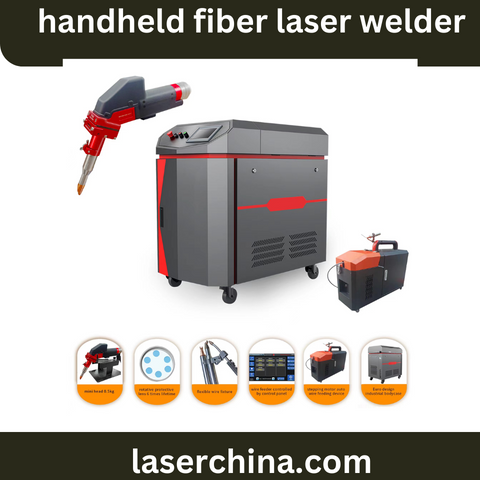
Why Is a Hand Held Fiber Laser Welder Becoming Essential for Modern Metalwork
Modern metal fabrication requires equipment that can handle different materials, production requirements, and workshop environments with consistent results. As manufacturers look for practical welding solutions, laser welding technology has become an increasingly important part of industrial production. Among the available options, the hand held fiber laser welder provides a flexible approach for businesses working with stainless steel, carbon steel, aluminum, galvanized materials, and other metals.
Unlike traditional welding methods that often require extensive manual preparation and multiple supporting processes, laser welding uses a concentrated beam of light to create a precise connection between metal surfaces. The handheld design allows operators to guide the welding head across the workpiece, making the equipment suitable for different shapes, sizes, and fabrication applications.
Understanding Handheld Fiber Laser Welding
A hand held fiber laser welder is an industrial welding machine that uses fiber laser technology to produce a concentrated energy beam. The beam is directed toward the welding area, where the laser energy melts the surfaces of the materials and creates a strong joint as the molten metal cools.
The term “hand held” refers to the welding head, which an operator can manually move along the joint. This makes the system particularly suitable for workshops where products vary in dimensions or where fixed automated welding systems may not be practical.
Fiber laser technology has become widely used in metal processing because the laser source can deliver concentrated energy to a relatively small working area. This allows manufacturers to perform controlled welding operations while maintaining a clean and precise working process.
How the Welding Process Works
The welding process begins by positioning the metal pieces so that their edges or surfaces meet correctly. Depending on the application, the operator may prepare the joint before welding to ensure proper alignment.
The laser welding head is then positioned over the intended welding path. When the laser is activated, concentrated energy reaches the metal surface and creates a localized molten area. As the welding head moves along the joint, the molten material solidifies and forms a continuous connection.
Some applications may use shielding gas during the process. The gas helps protect the welding area from atmospheric contamination and supports a controlled welding environment.
The operator must select suitable welding parameters according to the material, thickness, joint design, and production requirements. Laser power, welding speed, wire feeding, and other settings can influence the final appearance and quality of the weld.
Materials Commonly Used
A hand held fiber laser welder can be used for a variety of metal fabrication applications. Stainless steel is one of the common materials processed with laser welding equipment because it is widely used in industrial products, kitchen equipment, architectural components, and machinery.
Carbon steel is another important material for welding applications. Manufacturers working with structural components, equipment frames, cabinets, and fabricated parts can use laser welding technology as part of their production workflow.
Aluminum requires controlled welding conditions because of its thermal characteristics and reflective surface. With appropriate machine settings and suitable operating procedures, fiber laser welding equipment can be used for aluminum fabrication.
Galvanized steel and other metal products may also be processed depending on the machine configuration, material thickness, and manufacturer's recommended operating conditions.
Applications Across Different Industries
Laser welding equipment is used across many industries because metal components appear in almost every type of modern manufacturing environment. Automotive workshops can use laser welding systems for selected vehicle components, brackets, panels, and fabricated parts.
In the production of stainless-steel products, laser welding can be incorporated into manufacturing processes involving cabinets, enclosures, frames, kitchen equipment, and decorative structures.
Machinery manufacturers can also integrate handheld laser welding into the fabrication of equipment components. The operator can work with different joint positions without being restricted to a single automated production setup.
The technology is also relevant to metal furniture, advertising equipment, electrical enclosures, sheet-metal fabrication, agricultural machinery, and general industrial repair work.
Handheld Operation in the Workshop
One of the important aspects of handheld laser welding is the operator's control over the welding head. Instead of moving a large workpiece through a fixed welding system, the operator can move the welding head around the component.
This approach can be useful when working with large frames, long metal sheets, irregular structures, or components that are difficult to position inside a fixed machine.
For workshop production, operators should maintain a stable welding path and follow the machine manufacturer's recommended procedures. Correct positioning, material preparation, parameter selection, and consistent movement all contribute to the welding process.
Proper training is also important. Laser welding equipment should only be operated by personnel who understand the machine controls, material requirements, laser safety procedures, and appropriate protective equipment.
Preparing Metal Before Welding
Material preparation plays an important role in laser welding. Before starting the operation, the workpiece should be inspected for excessive dirt, oil, moisture, rust, or other surface contamination.
The edges should be positioned correctly, and the joint should be checked for unwanted gaps or misalignment. Depending on the application, cleaning may be performed using suitable mechanical or laser cleaning equipment.
Good preparation helps establish a controlled welding process and makes it easier for the operator to maintain a consistent welding path.
Selecting Suitable Welding Parameters
Every metal welding application requires appropriate settings. There is no single parameter combination that works for every material and thickness.
Laser power must be matched to the application so that sufficient energy reaches the welding area. Welding speed also affects how much energy is delivered along the joint. When wire is used, the feeding rate must correspond with the selected welding conditions.
Manufacturers should test the settings on sample materials before beginning large-scale production. This allows operators to examine weld penetration, appearance, joint formation, and overall process consistency.
A controlled testing procedure can also help establish repeatable settings for frequently manufactured products.
Integrating Laser Welding Into Production
A hand held fiber laser welder can become part of a broader metal-processing workflow. In many workshops, metal sheets are first cut into required shapes before bending, assembling, and welding.
Laser cutting equipment can prepare accurate components, while bending machines can create the required profiles. The welding stage then joins the prepared parts into finished assemblies.
For businesses producing multiple product types, a handheld welding system can fit into workflows where production requirements change frequently. Operators can move between different components and welding positions according to the production schedule.
Maintenance and Operating Practices
Regular maintenance is essential for keeping welding equipment operating properly. Operators should follow the manufacturer's maintenance schedule and inspect components according to the recommended intervals.
The welding head, protective components, cooling system, gas connections, and other machine parts should be checked regularly. Consumable components should be replaced when required rather than continuing to operate with worn parts.
The working environment should also remain clean and organized. Dust, metal particles, and other contaminants should not be allowed to accumulate around sensitive machine components.
Following documented operating procedures can help workshops maintain consistent production practices and reduce avoidable equipment problems.
Laser Safety Considerations
Because laser welding uses concentrated laser energy, safety must be treated as an essential part of the working process. Operators should use the protective equipment specified by the machine manufacturer and follow applicable workplace laser safety requirements.
The welding area should be arranged appropriately to prevent unauthorized exposure. Proper ventilation and fume-management practices are also important because welding different metals can produce fumes and particles.
Operators should receive suitable training before using the equipment. Safety instructions should be clearly communicated to everyone working around the laser welding area.
Choosing a Machine for Your Workshop
When selecting a hand held fiber laser welder, manufacturers should consider their materials, typical thicknesses, production volume, workspace, and welding requirements.
Laser power is an important consideration, but it should not be evaluated separately from the intended application. The welding head, laser source, cooling arrangement, control system, wire-feeding options, and available support should also be considered.
Businesses should review the manufacturer's technical specifications and recommended material ranges before purchasing equipment. After-sales service, spare parts availability, operator training, and technical support can also influence the long-term usability of a welding system.
The Growing Role of Laser Welding
As metal fabrication continues to adopt more precise processing technologies, laser welding is becoming an important option for workshops and manufacturers. The combination of concentrated laser energy and handheld operation creates a flexible approach to joining metal components.
For businesses handling different fabrication jobs, the technology can support a wide range of production requirements when the machine is correctly selected, configured, and operated.
The hand held fiber laser welder represents a modern approach to metal joining, bringing fiber laser technology into a format that can be used across varied workshop applications. With suitable material preparation, parameter selection, operator training, and safety procedures, it can become an important part of contemporary metal fabrication.
Final Thoughts
Laser welding continues to develop as manufacturers search for reliable ways to process metal components with controlled and repeatable results. A hand held fiber laser welder provides a practical format for workshops that need to work with different components, joint positions, and fabrication requirements.


