
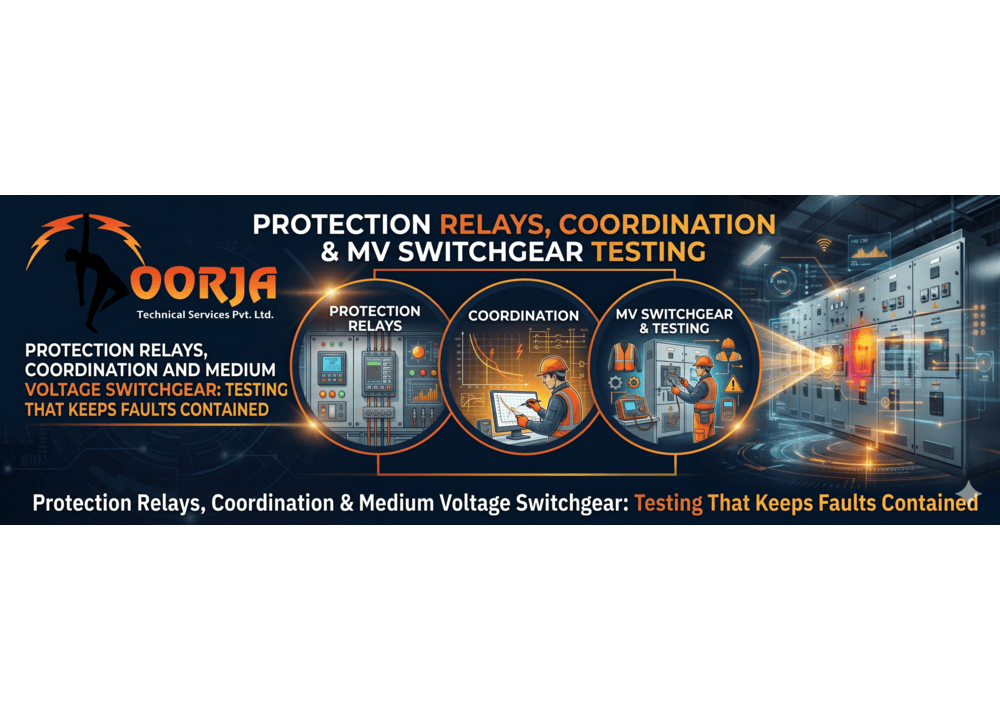
Protection Relays, Coordination and Medium Voltage Switchgear: Testing That Keeps Faults Contained

A circuit breaker can only interrupt a fault if it receives the correct trip command at the correct time. That command comes from the protection relay, which depends on accurate current and voltage signals, correct settings and healthy wiring. If any link in this chain is wrong, a small fault can spread, taking out upstream equipment and shutting down far more of the plant than necessary.
This is why switchgear health cannot be judged by looking at the breaker alone. The entire protection scheme has to be tested.
The Role of Protection in a Power System
Protection systems have three goals: detect abnormal conditions such as short circuits, earth faults and overloads; disconnect only the faulty section; and do it quickly enough to limit damage and keep the rest of the network running. These goals require relays, instrument transformers, trip circuits and breakers to work together perfectly.
Modern numerical relays offer many functions, such as overcurrent, earth fault, differential, directional, under and over voltage, and more. But more features also mean more settings, and more scope for error if they are not verified.
Testing the Protection Chain
A complete switchgear protection system testing exercise does not stop at checking that the relay powers up. It verifies the whole path from sensor to breaker:
-
CT and VT checks: ratio, polarity, magnetisation and burden tests confirm the relay sees the right signals.
-
Relay injection testing: secondary injection (and primary injection where required) confirms pickup values, operating times, and curve characteristics against the approved settings.
-
Trip circuit verification: trip coil healthiness, supervision, lockout relays and auxiliary contacts are checked.
-
Interlocking and alarms: scheme logic, SCADA signals and annunciation are tested end to end.
-
Breaker operation: actual tripping of the breaker by the relay is proven, with timing recorded.
Why Coordination Matters
Coordination means that protective devices at different levels operate in a planned sequence. The device closest to the fault should clear it first, and upstream devices should act only as backup. If settings are not coordinated, a minor fault on an outgoing feeder may trip the incomer and black out the whole substation.
Plants change over time. New loads are added, transformers are replaced, generators are introduced and fault levels shift. Settings that were correct at commissioning may no longer be suitable. Periodic relay and switchgear coordination testing checks existing settings against the present network, confirms that time-current curves still grade correctly, and verifies that the relays actually behave as the study assumes.
Special Focus: Medium Voltage Switchgear
Medium voltage panels (typically from 3.3 kV up to 33 kV) are the backbone of large plants, feeding transformers, motors and long cable networks. Their failure usually means major loss. Dedicated medium voltage switchgear testing services normally include:
-
Insulation resistance and, where recommended, power frequency withstand tests
-
Contact resistance of breakers, isolators and bus joints
-
Vacuum interrupter integrity checks or SF6 gas quality and leakage checks
-
Breaker timing, travel and synchronism measurements
-
Protection relay and CT/VT testing
-
Partial discharge or ultrasonic and thermal surveys, where applicable
Because MV equipment operates at higher energy levels, testing must be done by trained engineers following strict safety procedures, proper isolation, earthing and permit systems.
Advantages of On-Site Testing
Shifting heavy equipment or removing panels to a workshop is costly and disruptive. Choosing an on-site switchgear maintenance service lets the work be carried out right inside your substation, under your own shutdown plan. Engineers arrive with portable test kits, perform the tests, carry out minor corrections such as cleaning, tightening and lubrication, and hand over a report on the spot or within a short time.
On-site work also allows testing to be sequenced feeder by feeder, so the overall outage period is kept as short as possible.
Preparing for a Testing Shutdown
A few simple steps make the shutdown smoother:
-
Share single line diagrams, previous reports and relay setting files with the service team in advance.
-
Plan the outage sequence and confirm permit and isolation responsibilities.
-
Keep critical spares such as trip coils, fuses and auxiliary contacts available.
-
Ensure safe access, adequate lighting and a clean working area around the panels.
-
Decide in advance how corrective actions and re-testing will be handled.
Conclusion
Reliable power depends on more than healthy breakers. It depends on correct protection, tested coordination and well-maintained medium voltage equipment. Regular testing of the complete protection chain gives you confidence that, when a fault does occur, it will be cleared quickly, selectively and safely.
About Oorja Technical Services Pvt Ltd: Oorja Technical Services Pvt Ltd delivers electrical testing, protection system verification and maintenance services with a focus on safety, accuracy and clear reporting.
Contact: [email protected] | +91-9907759797 | oorjatechnical.in


