
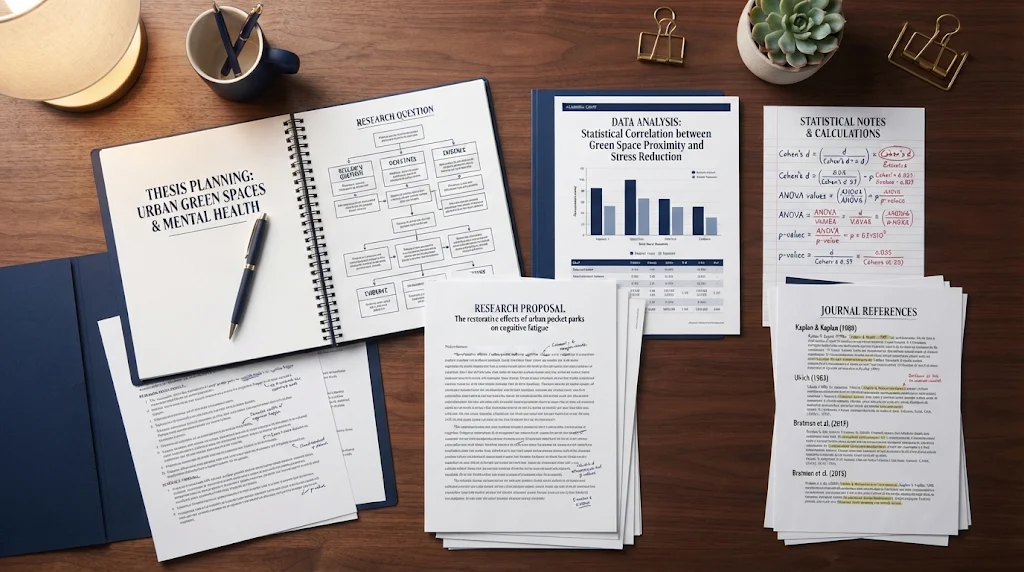

You have chosen a subject, gathered a folder of journal articles and perhaps started drafting a proposal. Then one question stops everything: what, exactly, are you trying to find out?
That is where dissertation planning turns uncomfortable. One study points to a new variable, another offers a competing explanation, and your original idea slowly becomes too big for one dissertation.
The answer is not more objectives or heavier academic language. It is choosing one worthwhile problem and checking honestly whether the evidence within your reach can answer it.
A well-defined question gives the literature review, methodology and discussion a shared direction. A poorly defined one leaves each chapter addressing a slightly different problem.
Turning a Broad Subject Into a Research Question
Take employee motivation. You could read for weeks about leadership, pay, culture and career development and still have nothing to investigate. Collecting information is not the same as answering something.
A question names a relationship. For example:
How do professional development opportunities influence employee motivation in UK retail organisations?
Now there is a factor, a population and a setting. You know which literature matters and what evidence might help.
At final-year and postgraduate level, describing established theories is rarely enough. Your discussion needs to weigh competing arguments, compare findings and consider the limitations of existing research. A master's thesis generally demands greater analytical depth, while a doctorate is expected to make an original contribution to knowledge.
A research question gives your project a clear, defensible purpose. It is not there to make a topic sound academic.
Where Students Get Stuck
A common mistake is choosing a subject because it sounds interesting before checking whether it can support a focused investigation.
Take social media and academic performance. Does the study look at concentration, grades, sleep or participation? These are related but not interchangeable, and each needs different data collection and analysis. Covering all of them leaves the project too broad to produce meaningful findings.
Then there is drift. One article introduces a variable, the next raises another perspective, and the original question gets buried under ideas that were never part of the aim.
Questions do change as understanding grows, and that is healthy. The trouble starts when every interesting finding is allowed to steer the project.
Access causes problems too. Imagine a project built on interviewing employees at one organisation. The question may be sound, but a refusal could make the data collection impossible. Check access before you finalise the methodology, not after weeks spent drafting interview schedules.
Questions about structure and methodology often come up around Thesis Writing Services, and wanting a second pair of eyes is reasonable. Whatever support you use, you must be able to justify the question, explain the evidence it needs and make the design decisions yourself.
Three Frameworks Worth Borrowing
FINER asks whether your question is Feasible, Interesting, Novel, Ethical and Relevant. Feasibility deserves particular attention. A study across several NHS trusts needs extensive permissions, recruitment and coordination. A master's student with a limited timeframe and no established access should aim smaller.
Novel does not mean untouched. A fresh contribution can come from an overlooked group, conflicting findings or a familiar approach in a new setting.
PICO stands for Population, Intervention, Comparison, Outcome. It suits clinical and quantitative questions, such as whether a structured exercise programme improves mobility in older adults compared with usual care. It fits badly when you are exploring how people interpret experience.
Research gaps need careful handling. A gap is something you establish through critical reading, not something you assume because a search returned few results.
Say some studies link flexible working to higher job satisfaction, while others suggest the relationship depends on management support. Do not treat that as a simple disagreement. Compare the populations, working arrangements and measures used, because those differences may reveal a more precise question.
Checking Whether Your Evidence Is Within Reach
A question can be answerable in theory and still unsuitable for your project. The issue is not whether relevant information exists, but whether you can obtain enough appropriate evidence to answer convincingly.
Try completing this sentence with your draft question:
"To answer this question, I need [specific evidence] from [source], collected through [method], by [realistic date]."
If a blank stays empty, the question is not ready. If the source is one organisation, one gatekeeper or a dataset you have not seen yet, it is fragile.
Then sketch an alternative design before committing. If access to one firm is refused, you might approach a broader population or use a suitable public dataset. But the new source must still measure what your question asks about, and changing the evidence may mean changing the question.
An afternoon on this now can save a panicked redesign in month four.
Sharpening a Working Question
A research question rarely arrives in final form. Start with a provisional version and test each part against the subject, the evidence and the method.
Say your interest is remote working and performance. First attempt: How does remote working affect employee performance? Which employees? What kind of remote working? Performance measured how?
A more focused version: How do employees in UK financial services organisations perceive the relationship between hybrid working and their individual productivity?
That distinction matters when choosing a method. Interviews can show how employees understand and describe their productivity, but they cannot establish an objective improvement in performance on their own. The wording of the question must match the evidence the research can produce.
Examine how findings were produced, not just what was concluded. Look at the sample, design, measures and limitations. If two studies disagree, check whether they used different populations or defined the outcome differently.
Choose the method your question needs. Interviews can explain why employees prefer hybrid working. Testing its association with productivity requires suitable measures and data. The question decides, not which method looks more sophisticated.
Finally, draft a provisional answer. You are not guessing findings, just working out what evidence would make a response convincing.
Mistakes That Cost Marks
Some weaknesses are easy to miss at proposal stage but cause trouble later.
Complexity over clarity. Long questions with several variables look impressive and read badly. Rewrite anything a reader struggles to follow.
Baking in the answer. "Why does poor leadership reduce motivation?" assumes both poor leadership and falling motivation. Ask how leadership practices relate to motivation instead.
Confusing association with causation. If two variables change together, other factors may explain it. Unless your design supports a causal reading, describe the association carefully.
Letting the design lag behind the question. If reading shifts your focus, check that the objectives, participants and methods still fit.
Final Thoughts
A strong question is not the one with the most literature behind it. It names a worthwhile issue and can be answered with evidence suited to your project's scope.