

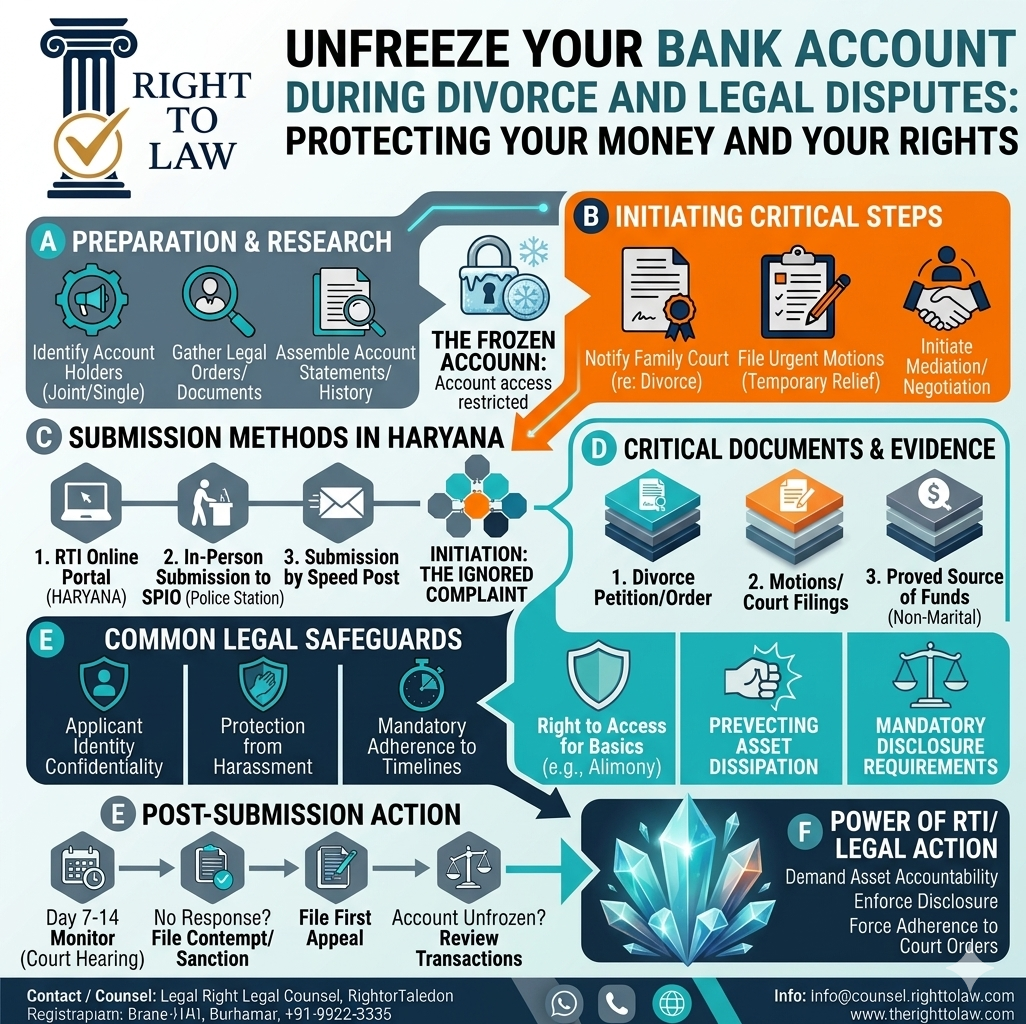
Unfreeze Your Bank Account During Divorce and Legal Disputes: Protecting Your Money and Your Rights

Divorce Is Already Painful — A Frozen Bank Account Should Not Make It Worse
Separation and divorce are among the most emotionally and financially draining experiences any person can go through. And yet for thousands of individuals across India, the pain is intensified dramatically when they discover that their bank account has been frozen often without warning in the middle of an already difficult legal dispute.
A frozen bank account during a divorce or marital separation can leave you unable to pay for basic necessities, legal fees, housing, or your children's needs. It is a situation that demands immediate, informed action.
This guide explains exactly why bank accounts get frozen during legal disputes, what your rights are as an individual, and the precise steps you need to take to unfreeze your bank account and protect your financial independence during one of the most challenging periods of your life.
Why Bank Accounts Get Frozen During Divorce and Legal Disputes
Understanding the specific trigger for your account freeze is the foundation of every effective resolution strategy.
Court-Ordered Freeze During Matrimonial Proceedings
Family courts in India have the authority to issue interim orders freezing bank accounts during divorce and matrimonial dispute proceedings. These orders are typically sought by one spouse to prevent the other from withdrawing or transferring assets before a final settlement is reached. If your spouse's lawyer filed for an injunction and the court granted it, your bank is legally obligated to comply immediately.
Domestic Violence Act Financial Remedies
Under the Protection of Women from Domestic Violence Act, 2005, courts can issue protection orders that include financial controls — including restrictions on a spouse's access to shared or individual bank accounts. These orders are designed to protect the financially dependent spouse but can sometimes affect the other party's accounts as well.
Dispute Over Joint Assets and Marital Property
When a legal dispute involves jointly held property, shared investments, or contested marital assets, courts may freeze individual accounts as part of broader asset preservation orders to prevent dissipation of marital wealth before the case is resolved.
Third-Party Legal Claims During Business or Partnership Disputes
In some cases, a legal dispute that begins as a business or partnership disagreement can escalate to the point where a court freezes the individual bank accounts of the parties involved — even if the account holder is not the primary subject of the dispute.
Your Rights When Your Account Is Frozen During a Legal Dispute
Before taking action, understand clearly what you are legally entitled to:
- You have the right to be formally served with the court order that resulted in the freeze — you cannot be legally frozen without a court process
- You have the right to engage legal counsel and respond to the court order within the prescribed timeframe
- You have the right to apply to the court for a modification of the freeze order to allow access to funds for basic living expenses
- You have the right to challenge the freeze order if it was obtained through misrepresentation or procedural error
- You have the right to request the court to release specific funds for your children's education, medical needs, or household maintenance even while the broader freeze remains in place
How to Unfreeze Your Bank Account During Divorce or Legal Disputes: Step-by-Step
Step 1: Obtain and Review the Court Order Immediately
The very first step is to contact your bank branch and obtain a complete copy of the court order that directed the freeze. Read it carefully — or have your lawyer read it — to understand exactly what the order covers, which accounts are affected, what amounts are frozen, and what legal process was followed to obtain it. This document is the foundation of your entire response strategy.
Step 2: Engage a Family Law Attorney Without Delay
A dispute-related account freeze is a legal matter that absolutely requires professional legal support. Engage a qualified family law attorney immediately. They can review the court order, assess its validity and scope, advise you on the fastest path to relief, and file the necessary applications on your behalf to modify or vacate the freeze order.
Do not attempt to negotiate directly with your spouse or their legal team without your own legal representation in place.
Step 3: File an Application for Interim Relief
Through your lawyer, file an urgent application before the family court requesting interim relief from the account freeze. In your application, clearly demonstrate your immediate financial need — your inability to pay rent, utility bills, children's school fees, medical expenses, or legal costs — and request the court to release a specific portion of your funds for these essential purposes.
Indian family courts regularly grant such interim relief applications where genuine financial hardship is demonstrated. The key is acting quickly and presenting your case with complete supporting documentation.
Step 4: Challenge the Freeze Order If It Was Wrongly Obtained
If you believe the court order freezing your account was obtained through misrepresentation, suppression of facts, or procedural violations — your lawyer can file an application to vacate or modify the order. This application must be supported by documentary evidence and a clear legal argument. Courts take seriously any attempt to misuse freeze orders as a financial pressure tactic during matrimonial disputes.
Step 5: Open a New Individual Account for Immediate Needs
While your legal challenge is being processed, open a new individual bank account at a different bank to manage any new income or incoming funds. Inform your employer, clients, or any payment sources to redirect payments to this account immediately. This provides essential financial breathing room while the court process unfolds.
Step 6: Attend Every Court Hearing and Follow Up Consistently
Stay actively engaged in the legal process. Attend every hearing related to the freeze order, respond promptly to every court notice, and follow up with your lawyer regularly for updates. Courts respond more favourably to applicants who demonstrate active participation and good faith in the legal process.
Protecting Your Finances During and After the Dispute
Once you successfully unfreeze your bank account, take these proactive steps to protect your financial independence going forward:
- Maintain a completely separate individual bank account at all times — never rely solely on joint accounts during a troubled relationship
- Keep personal savings, income records, and financial documents organised and accessible at all times
- Regularly review all joint account mandates and update them immediately upon any legal separation
- Consult a financial advisor alongside your legal team to protect your long-term financial interests during the divorce process
Conclusion
A frozen bank account during a divorce or legal dispute is frightening — but it is never a permanent situation. With immediate legal support, a clear understanding of your rights, and prompt action through the court system, you can successfully unfreeze your bank account and restore the financial independence you need to navigate this difficult chapter of your life.
Act immediately. Engage a lawyer. Know your rights. And remember — the court system has provisions specifically designed to protect individuals from financial hardship during legal disputes.


