


Elements of a Faithfully Recreated Viking Sword
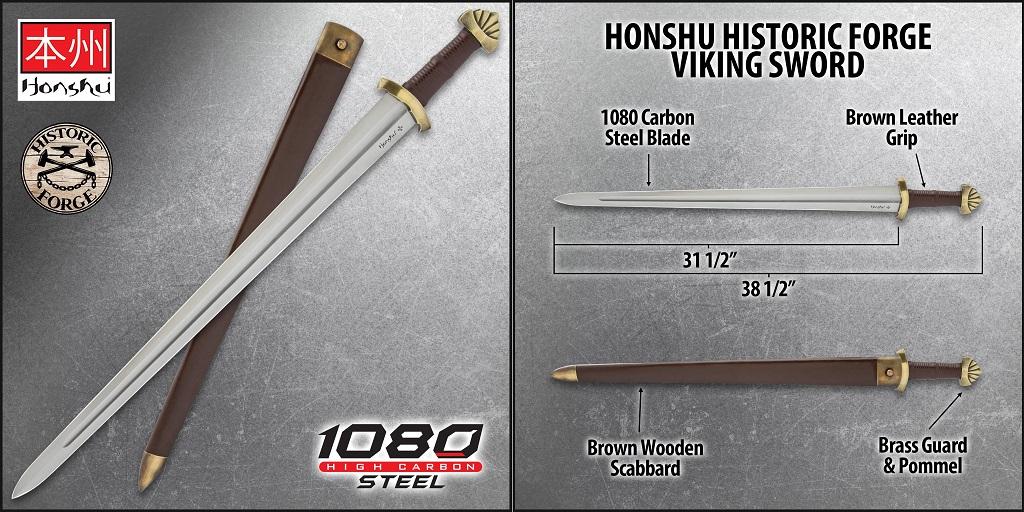
Viking swords are enduringly popular in the mind of the people, and though the image of the bearskin-cloaked viking with a horned helmet might be more recognizable, the axe or sword he (or she) wields is certainly not without its character.
That begs the question, what are the elements of a typical Viking sword? While there is no single pattern that could or could not be called Norse, you can know one by its attributes, the chief of which will be covered here.
The Blade
Most Viking swords were made with relatively short, broad blades that were chiefly designed for slashing rather than thrusting. Some of them even had slightly rounded-off points.
Expect a blade of between 20 to 30 or so inches. The majority of Viking swords were double-edged, unless you consider the seax or sax a sword, in which case it would have had a single edge (although, a sax is an entirely different pattern altogether, despite the fact that it is distinctly Northern European as well).
In addition, the typical Viking blade would have had a deep, wide fuller (a groove down the middle of the blade) that, contrary to popular opinion, was for the purpose of lightening and strengthening the blade, not for allowing blood to drain from an opponent.
The blade may also have been inscribed with runes or marked by the maker.
The Hilt
All else being equal, it is the hilt of a Viking sword that is its most distinctive and identifying attribute. Most Viking swords were made with short hilts that were intended to accommodate only one hand.
They were mostly made of wood wrapped in leather and as a result, many surviving examples have lost these ornamentations, with only the tang remaining.
Nonetheless, the hilt may have been ornately graven or have had the leather tooled, and it may have been embellished with runes or attractive precious or semi-precious metal scrollwork.
The crossguard would have been either short and straight, only extending slightly past the width of the blade, or it would have sloped forward slightly. Special notes are needed to characterize the pommel.
The Pommel
Almost by the pommel alone can you identify a Norse sword. Overwhelmingly, they were made with lobed pommels with an odd number of lobes shaped like lozenges. Three and five are the most common numbers, although some plain patterns also had a single, nut-shaped lobe for a pommel.
The Sheath
The sheaths of most Norse swords were typically made with a combination of wood and leather. They may have been either plain or, as the hilt, ornately decorated.
The throat and chape of the sheath or scabbard would have been capped with either brass or some other metal alloy to protect against wear. This is reflected in modern Norse sword replicas.
Because they were made of wood and leather, these, like the hilts of original swords, have often not survived.
Other Names for a Viking Sword
Viking swords may also have been called Norse swords, Norman swords, Carolingian swords, and by other names. They were similar to Merovingian swords and may have represented an evolution from or iteration of earlier patterns such as knightly swords. The Norse may have also had a habit of giving names to individual swords, although this would not reflect upon the pattern of the sword.
Where to Get Realistic Viking Sword Reproductions
Here because you’re in the market for a faithfully reproduced Viking sword or seax? Make your first stop online at True Swords. They carry a wide range of replica blade swords and battle ready swords and there are a fair number of Norse patterns in their collection.
For More Information About Wakizashi Katana and Sword Modern Please Visit: True Swords.
 Portuguese
 English
 Arabic
 French
 Spanish
 Deutsch
 Turkish
 Dutch
Dutch
 Italiano
 Russian
 Romaian
 Portuguese (Brazil)
 Greek
Greek