
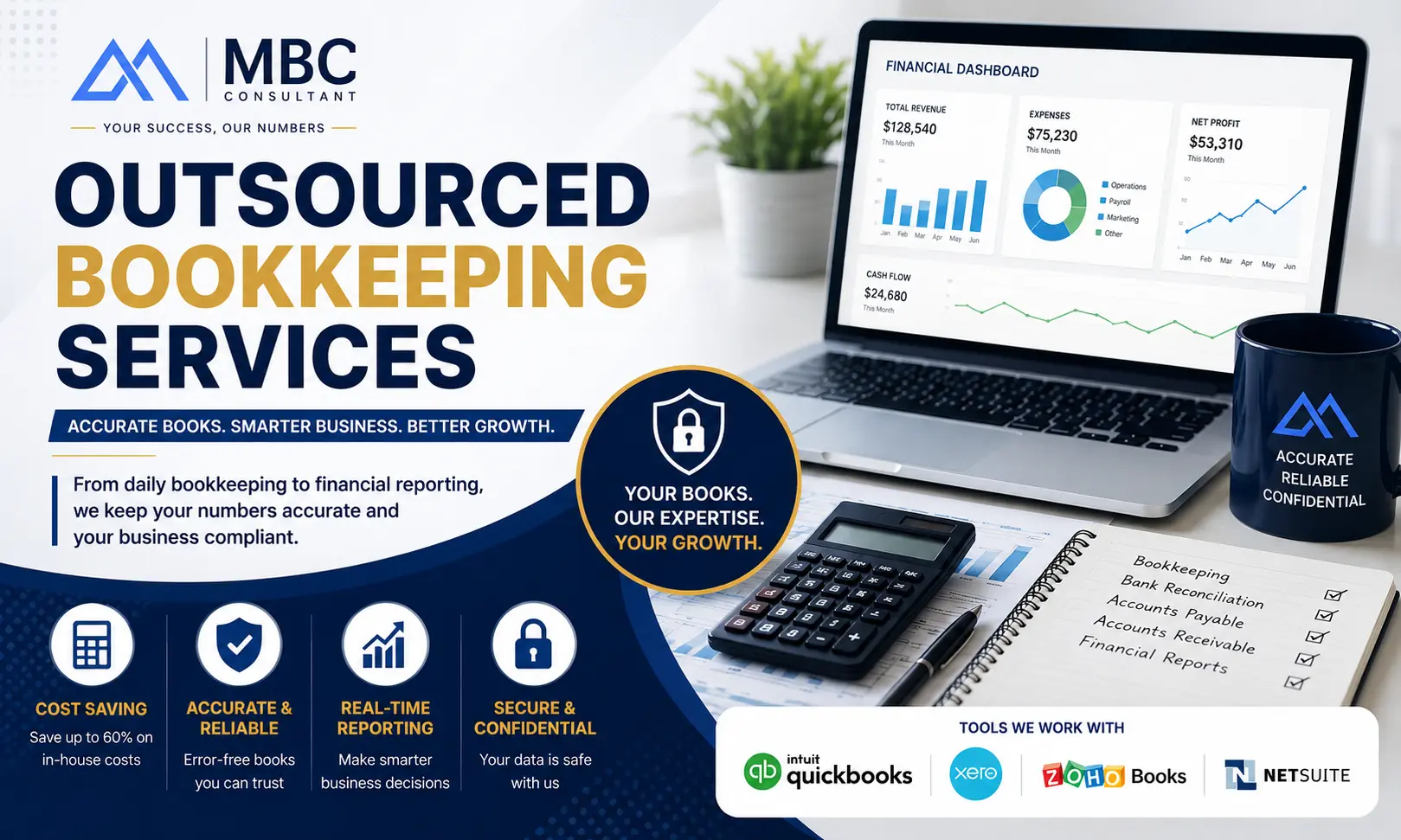
Expert Outsourced Bookkeeping Services for Growing UK Businesses

Expert Bookkeeping, Tailored to Your Business Needs
Picture this: it is the final week of the month, your sales have been strong, invoices are moving, staff are busy, and yet you still cannot answer one simple question with confidence: how healthy is the business financially? The problem is rarely a lack of ambition. More often, it is the lack of a reliable bookkeeping routine behind the scenes.
For growing UK businesses, Outsourced Bookkeeping Services can turn that uncertainty into clarity. Rather than allowing financial records to become another task on an already crowded management list, businesses can use a structured external team to keep transactions organised, accounts reconciled, and reporting ready.
Good bookkeeping is about creating trustworthy financial information that supports decisions. When the books are clean, leaders can see where money is going, understand performance, prepare for tax deadlines, and plan the next stage of growth with greater confidence.
Why Bookkeeping Matters More as Your Business Grows
When a business is small, an owner may know almost every transaction personally. That changes quickly as sales increase, suppliers multiply, employees join, expenses grow, and new projects create more financial activity.
A growing organisation needs dependable financial record keeping, not occasional catch-up work. Delayed entries can make cash flow appear healthier or weaker than it really is. Unreconciled bank accounts can hide mistakes. Missing receipts can complicate expense claims. Inconsistent coding can distort management reports.
Timing matters.
Decision-makers need information. If the numbers arrive weeks after the activity happened, the business has already lost part of the opportunity to respond. Reliable monthly bookkeeping creates a rhythm where financial information is maintained continuously rather than reconstructed under pressure.
Professional bookkeeping supports cash flow management, budgeting, tax readiness, supplier relationships, and meaningful conversations about profitability.
What Are Outsourced Bookkeeping Services?
Outsourced Bookkeeping Services involve working with an external specialist team that manages agreed bookkeeping activities on behalf of a business. Depending on the business model, that support may include transaction processing, bank reconciliations, accounts payable and receivable, expense recording, month-end preparation, and management reporting.
The strongest outsourcing models are tailored rather than generic. A consultancy with recurring client invoices does not have the same needs as a retailer managing high transaction volumes. A construction company may need careful project cost tracking, while a professional services business may prioritise debtor control and monthly profitability.
Effective bookkeeping outsourcing starts by understanding the organisation, its existing systems, its reporting requirements, and its pressure points. The result should feel like an extension of the business, not a disconnected administrative function.
Bookkeeping Tailored to the Way You Work
There is no single bookkeeping package that works perfectly for every company. The right approach considers transaction volume, industry, accounting software, reporting frequency, internal responsibilities, and future growth plans.
A tailored service may include:
-
Bank reconciliations to compare recorded transactions with bank activity and identify discrepancies.
-
Accounts payable support to keep supplier records organised and obligations visible.
-
Accounts receivable support to improve invoice tracking and visibility over money owed.
-
Expense management to record spending consistently and retain supporting documentation.
-
Month-end close support to bring key records together on schedule.
-
VAT-ready bookkeeping to keep coding organised ahead of reporting periods.
-
Management accounts preparation to provide useful summaries for leadership teams.
-
Fixed asset tracking for accurate records of qualifying business assets.
-
Query tracking and review so unusual transactions and missing information are resolved promptly.
The value comes from how these activities connect. When each process follows a defined workflow, bookkeeping becomes more consistent, more transparent, and easier to review.
The Difference Clean Books Make to Decision-Making
Imagine choosing whether to hire another employee, increase marketing spend, purchase equipment, or accept a major new contract. Each decision affects cash, costs, margins, and working capital.
Without dependable numbers, business leaders are often forced to rely on instinct.
Strong financial reporting changes that. A current profit and loss view can show whether revenue growth is translating into profitability. A clear balance sheet can highlight outstanding liabilities and balance sheet risks. Cash flow information can reveal when money is expected to arrive and when significant payments are due.
This is why decision-ready reporting matters. Bookkeeping should not end with data entry. It should create reliable information that helps the people running the business understand what happened and decide what should happen next.
Why UK SMEs Are Turning to Outsourcing
For many UK SMEs, the challenge is not whether bookkeeping is important. It is how to access the right capability without creating unnecessary fixed overhead.
Hiring an in-house bookkeeper can be an excellent choice for some businesses, but it also brings recruitment, training, holiday cover, technology, management time, and continuity considerations. As the business changes, the role may also become too small for a full-time employee or too large for one person to handle comfortably.
Bookkeeping services for small businesses offer another route. An external team can provide access to multiple skills and structured processes while allowing support to increase or decrease as requirements change.
This flexibility is especially useful during periods of rapid growth, seasonal activity, acquisitions, system changes, or temporary finance backlogs.
The objective should not be outsourcing for the sake of outsourcing. It should be building a finance operation that fits the business economically and operationally.
Accuracy Requires Process, Not Just Good Intentions
Bookkeeping errors rarely happen because someone wants to produce poor work. They usually arise from rushed processes, inconsistent coding, missing information, unclear ownership, or insufficient review.
A professional bookkeeping process reduces these risks by defining how work enters the system, who completes each task, how exceptions are handled, and what is checked before information is finalised.
This is where quality assurance becomes important.
A dependable outsourced model may use documented checklists, review points, issue trackers, approval steps, and clear ownership. Separating day-to-day processing from independent review can provide another layer of control.
The benefit is less rework.
When teams do not have to repeatedly correct the same issues, month-end becomes calmer. Finance staff spend less time hunting for missing information. Business owners receive reports more predictably. Over time, disciplined workflows create a more stable financial operation.
Cloud Bookkeeping and Better Financial Visibility
Modern bookkeeping is increasingly connected to cloud accounting systems. Tools such as Xero and QuickBooks can make information more accessible, support automation, and simplify collaboration between business leaders and finance teams.
However, software alone does not create good bookkeeping.
A cloud platform still depends on accurate coding, reconciliations, review procedures, sensible user permissions, and consistent data entry. Technology can speed up a process, but it cannot replace judgement when a transaction looks unusual or information is incomplete.
This is why cloud bookkeeping services work best when technology and human oversight are combined. With the right structure, businesses can gain more timely access to financial data while keeping controls around sensitive information.
Real-time access helps leaders monitor performance between formal reporting cycles.
Bookkeeping That Scales With Your Business
A bookkeeping solution should not become a bottleneck when the business succeeds.
As transaction volumes rise, businesses may need stronger accounts payable and receivable, more frequent reconciliations, expanded reporting, or additional support around month-end. A scalable provider can adjust capacity without forcing the company to redesign its entire finance function every time demand changes.
This matters because growth rarely happens in a perfectly predictable pattern.
One quarter may involve rapid sales growth. Another may bring a temporary slowdown. A new contract may suddenly create more invoicing work. An acquisition may introduce additional entities or reporting requirements.
A flexible outsourced finance team can absorb these changes more smoothly when processes, ownership, and communication channels are already established.
The aim is simple: finance should support growth, not struggle to keep up with it.
Security and Confidentiality Are Essential
Financial records contain sensitive information, including customer transactions, supplier details, payroll-related data, invoices, and banking information. Any business considering outsourcing needs confidence that its information is handled responsibly.
Good financial data security starts with controlled access. Team members should have appropriate permissions, information should be shared through secure systems, and responsibilities should be clearly defined.
Confidentiality should also be supported by documented procedures. A mature bookkeeping operation makes it clear who can access information, how records are stored, and how exceptions are escalated.
Security is not an optional extra. It is part of professional financial management.
A Better Month-End Starts Before Month-End
Many finance teams feel pressure because month-end becomes a recovery exercise. Missing documents are chased, transactions are corrected, reconciliations are completed late, and management reports are rushed.
A better approach is to build a structured month-end close that spreads responsibility across the month.
Regular reconciliations, consistent transaction coding, supplier statement checks, expense review, and issue tracking can prevent small problems from becoming a large backlog. By the time month-end arrives, most of the work is already under control.
This creates a more predictable month-end reporting cycle and gives business leaders greater confidence in the figures.
It also changes the tone of the finance function. Instead of asking, “Are the numbers ready yet?” leaders can focus on what those numbers are telling them.
Choosing the Right Bookkeeping Partner
Not every bookkeeping provider operates in the same way. Price matters, but it should not be the only consideration.
Look for clear ownership, relevant experience, reliable communication, and a delivery model that matches your needs. Ask how reconciliations are reviewed, how issues are tracked, how reporting is delivered, and what happens when transaction volumes increase.
A strong provider should be able to explain its process in plain language.
It should also understand that every business has different priorities. Some need basic transaction support. Others need a more complete outsourced accounting solution covering bookkeeping, management reporting, tax-ready records, payroll coordination, and finance operations.
The best partnership is one where expectations are clear from the beginning and performance remains visible throughout the relationship.
Why UK-Led Oversight Can Add Confidence
For businesses working with remote or distributed teams, oversight matters. Clear leadership, defined responsibilities, quality checks, and regular reporting can make the difference between outsourcing that feels dependable and outsourcing that creates more questions.
A UK-led delivery structure can provide an additional layer of alignment for UK businesses, particularly when local expectations, reporting practices, and compliance requirements need to be understood.
This approach does not replace the value of specialist remote talent. It strengthens it by combining delivery capacity with clear accountability.
That combination is increasingly relevant to companies looking for UK bookkeeping support without carrying the full cost and complexity of a larger internal finance department.
The Real Benefit: Less Financial Friction
Perhaps the most practical benefit of professional bookkeeping is reduced friction.
When records are current, leaders spend less time asking for updates. When reconciliations are completed consistently, fewer mysteries appear at month-end. When invoices and supplier balances are organised, cash decisions become easier. When management reports arrive on schedule, meetings become more productive.
This is the quiet value of reliable bookkeeping.
It gives business owners and managers room to focus on customers, people, strategy, and growth instead of repeatedly fixing avoidable finance issues.
Final Thoughts
Your business deserves financial information that is accurate, timely, and genuinely useful. Outsourced Bookkeeping Services can provide that foundation by combining specialist expertise, structured workflows, technology, quality checks, and flexible support around the way your business actually operates.
Eco Outsourcing takes a process-led approach to bookkeeping, with UK-led oversight, regular visibility, documented workflows, specialist team structures, secure access controls, and support that can scale with changing business needs. The goal is not simply to keep the books updated. It is to create cleaner records, more predictable reporting, and stronger financial control.
For businesses that are tired of chasing transactions, repairing month-end issues, or carrying more finance workload internally than necessary, a tailored bookkeeping model can be a practical step toward smoother operations and better decisions.
When your bookkeeping works properly, you notice it everywhere. The numbers make more sense. The close feels calmer. Cash becomes easier to understand. And leadership can spend more time building the business rather than reconstructing its finances.