
What Determines Laser Welder Cost and How Can You Choose the Right Machine
When businesses consider upgrading their metal fabrication equipment, understanding laser welder cost is an important part of the purchasing process. Laser welding technology is increasingly used for joining stainless steel, carbon steel, aluminum, galvanized materials, and other metals with controlled heat and high processing accuracy. However, the price of a laser welding machine can vary considerably depending on its specifications, configuration, power, automation level, and intended application.
Rather than looking at the price alone, buyers should understand what contributes to the total investment. This makes it easier to select equipment that matches production requirements without paying for capabilities that may not be necessary.
Understanding Laser Welder Cost
The laser welder cost depends on several factors. Entry-level machines designed for lighter fabrication work are generally positioned differently from industrial systems intended for continuous production. Laser power is one of the most noticeable factors because higher-power equipment is designed to process thicker materials and support demanding applications.
A basic handheld laser welding system may be suitable for workshops that require flexibility and relatively straightforward welding operations. More advanced systems can include automated movement, specialized welding heads, integrated cooling systems, advanced control interfaces, and additional functions.
For this reason, two machines described as laser welders can have significantly different prices while serving completely different production requirements.
Laser Power and Its Influence on Pricing
Laser power plays a major role when evaluating laser welder cost. Common configurations are available in different power levels, with each designed for particular material thicknesses and production requirements.
Lower-power systems can be appropriate for thin sheet metal and general workshop applications. Higher-power laser welders are designed for deeper penetration and faster processing of thicker materials.
A buyer should first determine the materials and thicknesses that need to be welded regularly. Purchasing a machine with considerably more power than required can increase the initial investment, while selecting insufficient power may limit production capability.
Understanding the relationship between power and application helps businesses identify an appropriate machine before comparing prices.
Handheld Laser Welders and Their Applications
Handheld laser welders have become popular among metalworking businesses because they provide a practical approach to laser welding without requiring a large automated production line.
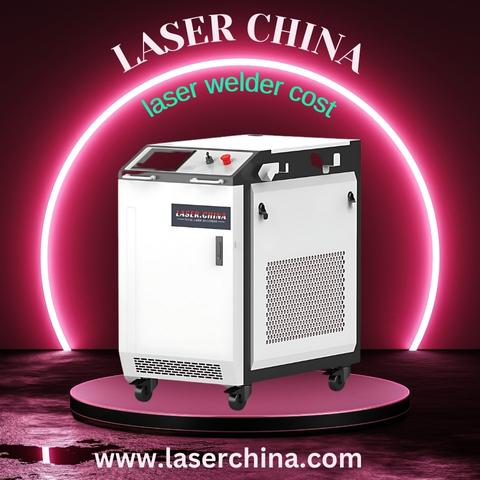
A handheld system normally combines a laser source, welding head, control system, cooling unit, and other necessary components into a compact configuration. Operators can move the welding head along the joint according to the requirements of the workpiece.
The laser welder cost for a handheld system depends on the laser source, power, configuration, welding head, cooling system, wire-feeding options, and included accessories.
These systems can be considered for applications such as metal fabrication, equipment manufacturing, kitchen equipment, doors and windows, automotive components, and general workshop production.
Fiber Laser Source and Overall Machine Pricing
The laser source is another important part of the machine and has a direct influence on the overall price. Fiber laser sources are widely used in modern welding equipment because they are designed for industrial processing and can provide consistent laser output.
Different manufacturers and laser-source configurations can result in different prices. When comparing machines, buyers should examine the complete system rather than comparing only the advertised laser power.
The quality and specification of the laser source, welding head, electrical components, cooling system, control system, and supporting equipment all contribute to the final laser welder cost.
Material Type and Thickness Requirements
The materials you intend to weld should be considered before selecting a machine. Stainless steel, mild steel, carbon steel, aluminum, brass, and galvanized materials can require different welding settings and techniques.
For example, a workshop producing decorative stainless-steel products may prioritize precision and controlled heat input, while an industrial fabrication company may require greater laser power for thicker components.
Defining the material range first allows buyers to compare machines according to actual production needs instead of choosing equipment based solely on price.
Cooling System and Operating Requirements
Laser welding generates heat, making an appropriate cooling system an essential part of the equipment. Many industrial laser welders use water-chilling systems to maintain suitable operating temperatures.
The cooling configuration can vary depending on machine power and manufacturer specifications. Higher-power systems may require more substantial cooling arrangements.
When calculating laser welder cost, buyers should consider the complete equipment package, including cooling equipment and other components necessary for normal operation.
This approach provides a more realistic understanding of the investment rather than focusing only on the base machine price.
Welding Head and Control System
The welding head is the component that directs the laser toward the workpiece. Different configurations can provide different levels of control and flexibility.
Modern machines may also include digital control interfaces that allow operators to adjust welding parameters according to material and application requirements. Depending on the model, the control system may provide parameter storage, monitoring functions, and simplified setup.
These components can influence the final machine price, particularly when comparing standard systems with more sophisticated industrial configurations.
Automation and Production Volume
Production volume is another factor that can significantly influence laser welder cost. A small workshop with occasional welding requirements may have different priorities from a factory operating multiple shifts.
Handheld equipment can be suitable when operators need to work with different shapes and components. Automated systems may be considered when production involves repetitive welding tasks and consistent positioning.
What Should Be Included in a Laser Welder Package?
Before purchasing a machine, buyers should carefully review what is included in the quoted price. A complete package may contain the laser source, welding head, cooling system, control unit, protective equipment, wire feeder, cables, and other accessories.
Different suppliers may offer different package configurations. Therefore, two prices cannot always be compared directly unless the included components are similar.
It is also useful to ask about installation instructions, operator training, technical documentation, warranty coverage, replacement components, and after-sales support.
Looking at the complete package provides a clearer picture of the actual investment.
Choosing a Laser Welder According to Your Workshop
The right machine should be selected according to the type of work your workshop performs. Start by listing the metals you commonly weld, their thicknesses, expected production volume, available workspace, and operator requirements.
Next, determine whether a handheld system is sufficient or whether your production process would benefit from automation.
Once these requirements are established, you can compare machines within the appropriate category. This makes it easier to understand why different suppliers quote different prices and prevents an unnecessary focus on the lowest advertised figure.
Evaluating the Long-Term Investment
The initial laser welder cost is only one part of purchasing equipment. Businesses should also consider operating requirements, maintenance, consumables, training, replacement components, and technical support.
A reliable machine with suitable specifications can become an important part of a workshop's production process. Proper operator training and routine maintenance can also help keep the equipment operating according to manufacturer recommendations.
Before making a purchase, request a detailed quotation and confirm the machine's specifications, included accessories, warranty conditions, delivery arrangements, and service availability.
Comparing Suppliers and Machine Specifications
When comparing suppliers, use the same specifications for each quotation. Ask for information about laser power, laser source, welding head, cooling system, control system, applicable materials, recommended thickness ranges, and package contents.
It is also worth checking whether the supplier provides technical assistance and replacement parts. A lower quoted price may not represent the same package as another supplier's quotation.
A detailed comparison helps businesses understand what they are actually purchasing and creates a more transparent basis for evaluating laser welder cost.
Final Thoughts
Understanding laser welder cost requires more than looking at a single price figure. Laser power, source type, welding head, cooling system, material requirements, automation, accessories, and supplier support can all influence the total investment.