
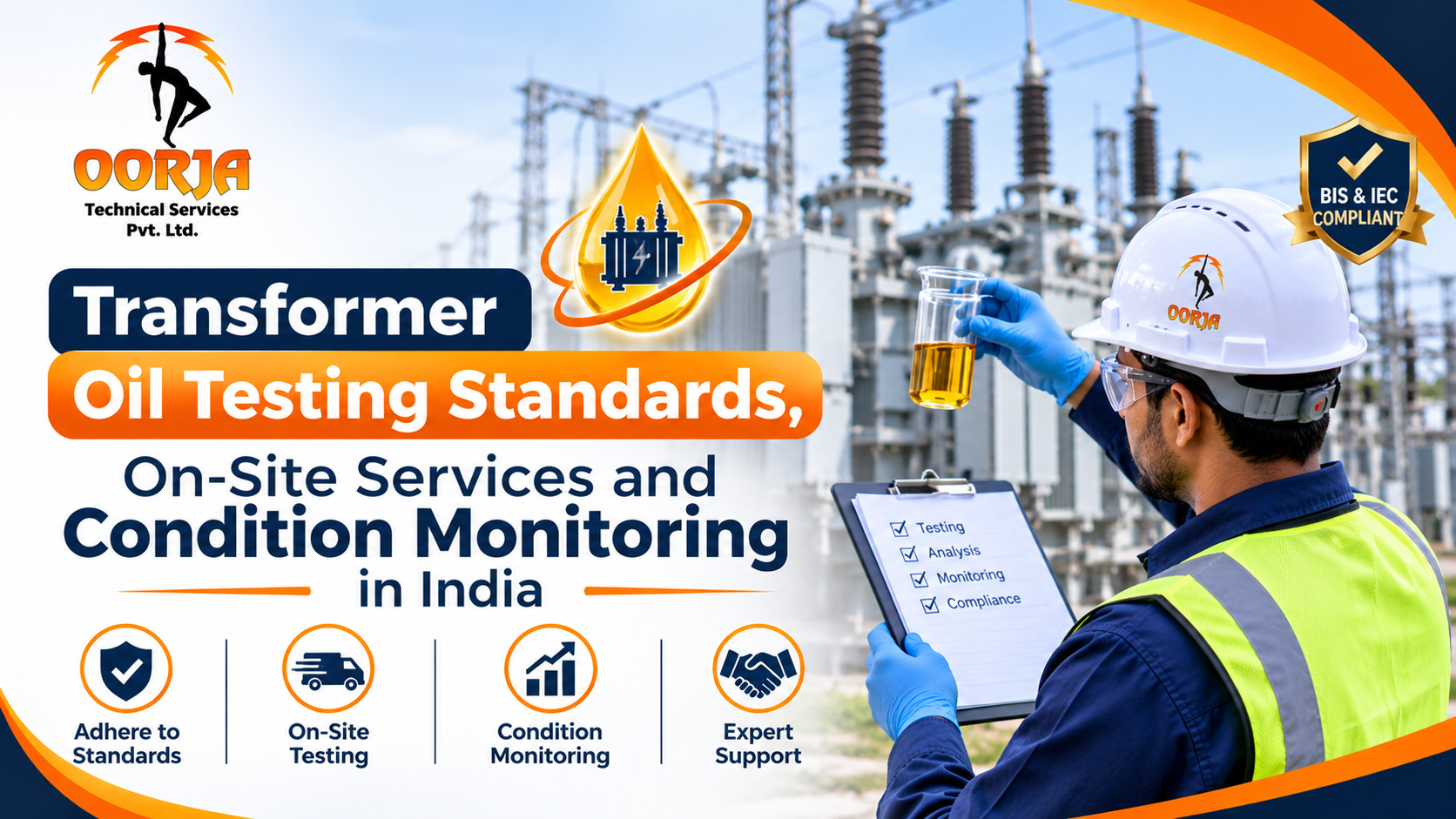
Transformer Oil Testing Standards, On-Site Services and Condition Monitoring in India
Every transformer oil report is only as meaningful as the standard behind it. A BDV value of 50 kV means very different things for fresh oil straight from the drum, for filtered oil after treatment and for oil that has been in service for ten years. This is why engineers who manage transformers need a clear idea of which Indian and international standards apply, and how testing services can be organised on site or in a laboratory.
The Standards Behind Oil Quality
Testing of new oil. New mineral insulating oil is purchased and accepted against a specification. In India, the traditional reference is IS 335, and internationally the equivalent is IEC 60296. Doing transformer oil testing as per IS 335 / IEC 60296 confirms that the oil delivered to your site has the required viscosity, flash point, pour point, water content, acidity, dielectric strength, oxidation stability and other properties. Testing at the time of delivery protects you from receiving substandard or mixed oil.
Maintenance of oil in service. Once oil is in the transformer, the focus shifts from acceptance to condition. IS 1866 gives guidance on the maintenance and supervision of insulating oil in service, while IEC 60422 does the same internationally. These documents set recommended limits and testing intervals according to the voltage class of the equipment.
Installation and maintenance of the transformer itself. IS 1886 is the code of practice for installation and maintenance of transformers. Transformer oil testing as per IS 1886 is commonly requested at the stage of commissioning, when the transformer is filled, processed under vacuum and tested before it is energised. A commissioning test report becomes the baseline for all later comparisons.
Test methods. Individual tests follow their own method standards, for example IEC 60156 for breakdown voltage, IEC 60567 for gas extraction and DGA, IEC 60599 for fault interpretation from gases, IEC 60814 for water content and IEC 61198 for furan analysis. A reliable laboratory will state the method used in every report.
Laboratory Testing or On-Site Testing?
Both have a place in a good maintenance plan.
Laboratory testing gives the most controlled conditions and the widest range of tests, including gas chromatography for DGA, HPLC for furans and precision tan delta measurement. It is the best choice for annual reviews, acceptance tests of new oil and detailed investigations after an alarm.
On-site testing saves time and avoids transport and sampling errors. An on-site transformer oil testing service is useful for quick BDV and moisture checks before charging a transformer, during oil filtration and processing, and in remote locations such as solar plants, wind farms, mines and construction sites where sending samples to a lab can take days. Field teams can also supervise filtration, confirm that the oil meets limits at each stage and help to decide when processing can stop.
Many customers combine both approaches: quick checks at site, and a full set of laboratory tests at regular intervals.
From Testing to Condition Monitoring
A single test result is a snapshot. The real value comes when results from different years are placed side by side. A structured programme of transformer oil testing and condition monitoring builds a history for every transformer in your plant and turns data into decisions.
A good monitoring programme usually has these elements:
-
A register of all transformers, with rating, make, year of manufacture, oil volume and last test dates.
-
A fixed testing schedule based on criticality, age and loading.
-
Trend charts for key parameters such as BDV, moisture, acidity and gas levels.
-
Clear action limits, for example when to filter, when to reclaim the oil and when to investigate the winding.
-
Fast follow-up sampling when any value changes suddenly.
When the programme is run well, planned shutdowns replace emergency failures, oil is treated only when needed and the useful life of transformers is extended. For high-value assets, even one avoided failure can pay for many years of testing.
Finding a Transformer Oil Testing Service Near You
If you are searching for a transformer oil testing service near me, the checklist is simple. Look for a lab that follows recognised standards, issues clear and signed reports, has experienced technical staff and can respond quickly. Local presence matters, because it means faster sample pick-up, shorter turnaround and easier site visits.
If your plant is in Madhya Pradesh or nearby states, a transformer oil testing lab in Indore can usually collect samples within a day and deliver reports in a short time. The same applies to industries in Pithampur, Dewas, Ujjain, Bhopal and other industrial belts around the city, as well as to customers across India who send samples by courier.
Beyond Oil: Electrical Testing Support
Oil is only one part of electrical asset health. Oorja Technical Services Pvt Ltd also supports customers with wider electrical testing and calibration needs, including work as an independent meter testing lab, so that your plant can manage transformers, meters and protection systems with one dependable partner.
Get in Touch
Whether you need testing of new oil, an annual DGA, a quick BDV check at site or a full condition monitoring programme, our team is ready to help.
Oorja Technical Services Pvt Ltd
Email: [email protected]
Phone: +91-9907759797
Website: oorjatechnical.in


