
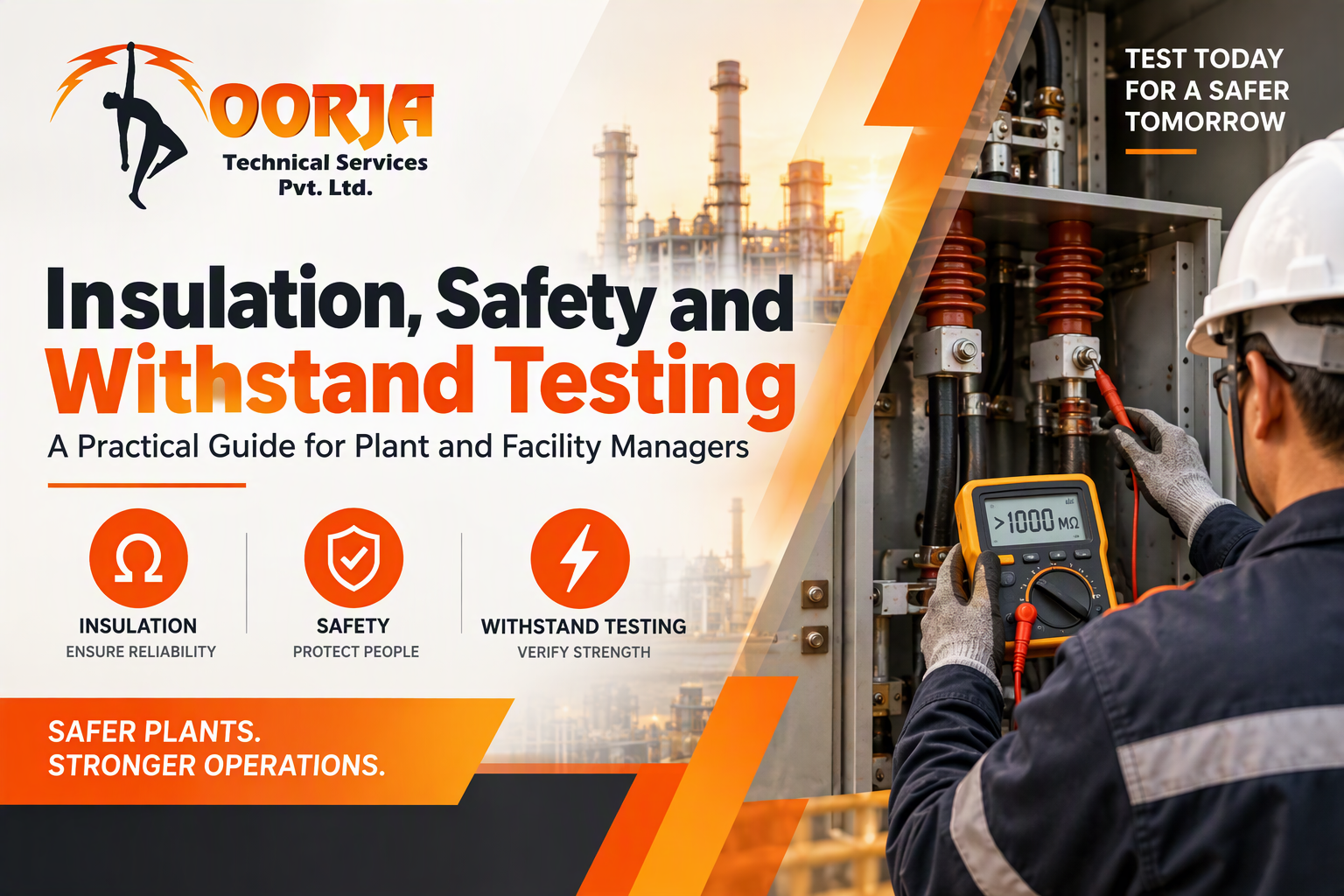
Insulation, Safety and Withstand Testing – A Practical Guide for Plant and Facility Managers
A large share of electrical accidents and fires in Indian factories, warehouses and commercial buildings can be traced to one simple cause: insulation that was allowed to fail. Insulation is the barrier that keeps current inside the conductor. It ages quietly through heat, moisture, dust, vibration and electrical stress, and for years it gives no sign of trouble. Then one day it breaks down, and the result is a short circuit, a shock hazard or a fire.
The only reliable way to know the condition of your insulation is to test it. Every serious provider of electrical testing services India-wide builds its work around a small set of proven tests. In this article, we explain what these tests do, when to use them and how they fit into an overall safety programme for your site.
Why Safety Testing Must Be a Routine, Not a Reaction
Many sites test only after something goes wrong. By then the damage is done: a burnt motor, a tripped plant, an injured worker or an insurance claim that gets questioned. A planned programme turns this around. Test results, repeated at regular intervals, show a trend, and a falling trend is a clear signal to repair or replace equipment before it fails.
A complete Electrical safety testing service normally covers:
-
Insulation testing of cables, motors, transformers, switchgear and busbars
-
Earthing and bonding checks, including continuity of protective conductors
-
Testing of RCCBs, ELCBs and other residual current devices
-
Verification of protection relay operation and breaker tripping
-
Thermal inspection of live panels for loose or overheating joints
-
A written report with measured values, pass or fail status and clear recommendations
These checks protect people first, equipment second and production third, and all three are worth protecting.
The Insulation Resistance Test: Your First Line of Defence
The simplest and most widely used check is the Insulation Resistance (IR) test. An insulation tester, often called a megger, applies a steady DC voltage, commonly 500 V, 1000 V, 2500 V or 5000 V depending on the equipment, between the conductor and earth, and measures the very small leakage current that flows. The result is shown in megohms.
How to read the results properly:
-
Absolute value: Compare the reading with the minimum limit given by the equipment standard or manufacturer.
-
Trend: A reading that falls year after year is a warning even if it is still above the limit.
-
Polarisation Index (PI): The ratio of the 10-minute reading to the 1-minute reading shows whether the insulation is dry and healthy or damp and contaminated.
-
Temperature correction: Readings must be corrected to a standard temperature, otherwise results taken in different seasons cannot be compared.
The test is non-destructive and quick, which is why it is used on cables, motors, generators, transformers and panels during every maintenance visit.
Hi-Pot Testing for Cables and Switchgear
An IR test tells you the condition of insulation at a modest voltage. But in real operation, insulation faces surges, switching spikes and the full service voltage. To check whether it can handle these, engineers use Hi-Pot testing, short for high potential testing.
A Hi-Pot test applies a voltage well above the normal rating for a fixed duration, while the leakage current is monitored. If the insulation is sound, the current stays low and stable. If it has a weak spot, moisture or a void, the current rises and the test stops, showing a defect that would otherwise have failed during service.
The test is commonly used on:
-
HT and LT power cables after installation, jointing or repair
-
Switchgear and busbar systems before energisation
-
Motors and generators after rewinding
-
Bushings, insulators and other high voltage components
For long cables, very low frequency (VLF) testing is often preferred because it needs a smaller test set and is gentler on the insulation than a conventional DC test.
The Dielectric Withstand Test Explained
The Dielectric Withstand Test is closely related to Hi-Pot testing and is often performed on new or reconditioned equipment to prove that it meets its design standard. A high AC or DC voltage is applied between live parts and earth, and between separate circuits, for a specified time, typically one minute. The equipment passes if there is no flashover, no breakdown and no excessive leakage.
Manufacturers carry it out at the factory, but a second test at site is just as important. Transport, storage and installation can all damage insulation, and a test at site confirms that the equipment is safe to energise.
Because the voltages involved are dangerous, the test must be carried out only by trained engineers who follow strict procedures: barriers and warning signs, grounding of nearby equipment, controlled voltage ramp-up and proper discharge of stored energy after the test.
Putting It All Together: A Simple Testing Schedule
Equipment
Suggested test
Typical interval
LT cables and motors
IR test with PI where possible
Every 6 to 12 months
HT cables
IR test and Hi-Pot or VLF test
Every 1 to 3 years
Switchgear and panels
IR test and dielectric withstand
Every 1 to 3 years
Transformers
IR, PI and oil tests
Every 12 months
New or repaired equipment
Full withstand test
Before energisation
The exact intervals depend on the age, location, load and criticality of the equipment, so always set them after discussing the site conditions with your testing partner.
Tips for Getting the Most Out of Your Tests
-
Plan tests during scheduled shutdowns so that production is not disturbed.
-
Use only calibrated instruments and ask for their certificates.
-
Keep every report in one file, so trends can be compared from year to year.
-
Act on recommendations quickly; a report that sits in a drawer protects nobody.
-
Choose a partner who offers on-site electrical testing and maintenance, so repairs and re-tests can be done in the same visit.
Conclusion
Insulation does not fail without warning; it only seems that way when nobody is measuring. A regular programme of IR, Hi-Pot and dielectric tests, backed by proper safety checks, is one of the most cost-effective investments an industry can make.
To book a testing visit or get a quotation, contact Oorja Technical Services Pvt Ltd at [email protected], call +91-9907759797 or visit oorjatechnical.in.


