
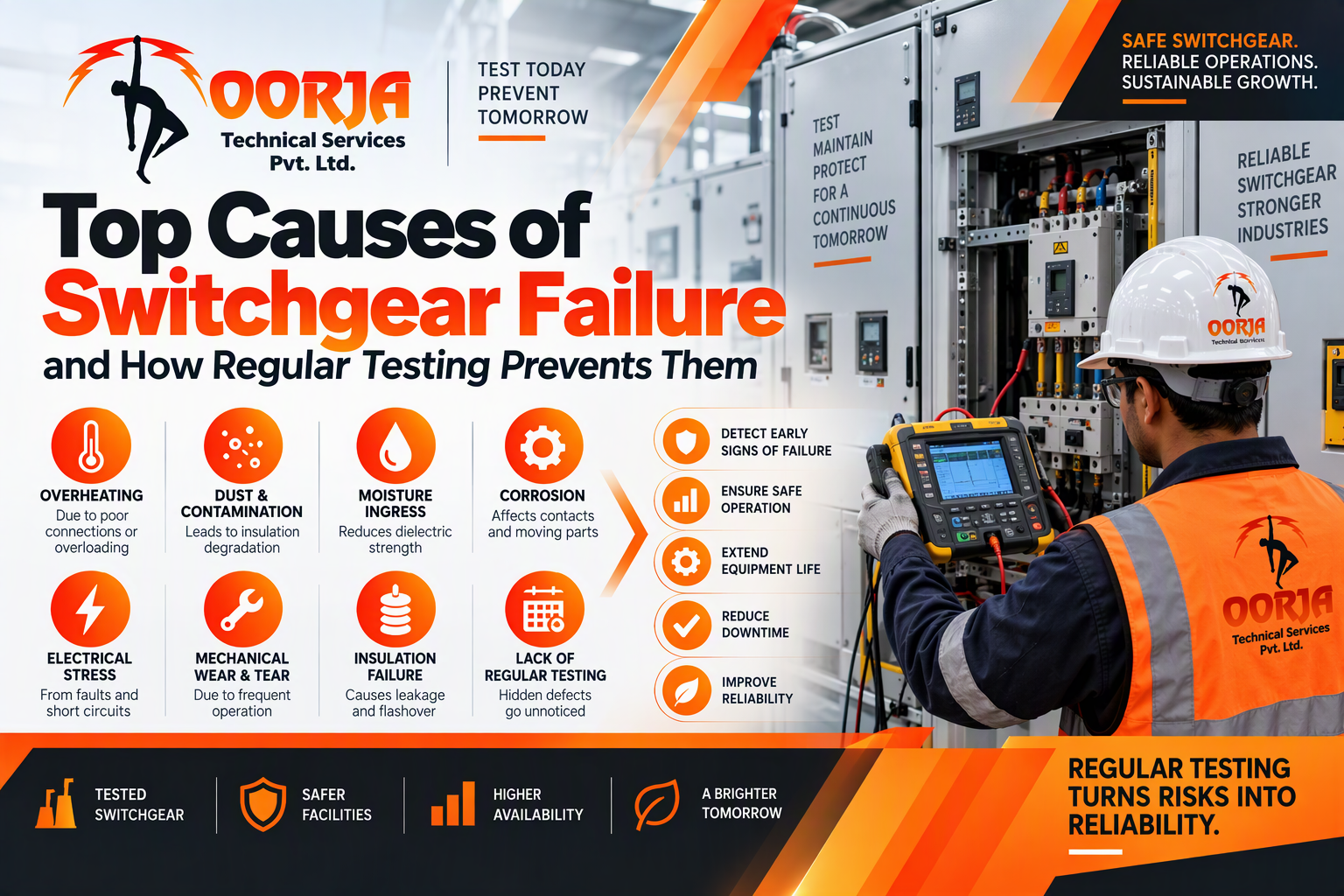
Top Causes of Switchgear Failure and How Regular Testing Prevents Them

Switchgear failures rarely arrive without warning. Behind almost every burnt busbar, tripped incomer or arc flash incident there is a slow, silent problem that went unnoticed for months or years. The good news is that most of these problems are detectable. With a disciplined programme of electrical switchgear testing and servicing, plants can find faults while they are still small, cheap and safe to fix.
In this article, we look at the most common causes of switchgear failure and the tests that expose them early.
1. Loose Connections and Overheating
Vibration, thermal cycling and poor workmanship slowly loosen bolted joints in busbars, cable lugs and breaker terminals. A loose joint has higher resistance, so it heats up under load. The heat oxidises the surface, which raises resistance further, and the cycle continues until the joint burns or the insulation nearby is damaged.
This failure mode is easy to prevent. Thermal scanning under load, torque checks during shutdowns and resistance measurements of joints and contacts will show a deteriorating connection long before it fails.
2. Insulation Breakdown
Insulation is the silent hero of every panel. Moisture, dust, industrial pollution, insects, rodents and normal ageing reduce its strength. Surface tracking can develop on dirty insulators in humid conditions, and partial discharge slowly erodes solid insulation from within.
A scheduled switchgear insulation resistance testing activity measures the actual condition of insulation between phases and to earth. A declining trend across successive tests is a clear signal to clean, dry out or replace components before a flashover occurs.
3. Mechanical Wear and Sluggish Operation
Circuit breakers are mechanical machines. Springs lose charge, latches wear, lubricants dry out and linkages collect dust. When a breaker is called to trip during a fault, a delay of even a few milliseconds can allow damaging fault energy to flow.
Breaker timing tests, travel curves, spring charging checks and manual operation exercises reveal these problems. Replacing lubricants and worn parts during planned outages is far cheaper than dealing with a breaker that fails to open on demand.
4. Protection Relay and CT Problems
A healthy breaker is useless if the relay does not command it correctly. Common issues include wrong settings after a plant modification, disabled protection functions, reversed CT polarity, open CT circuits, faulty trip circuits and dead auxiliary supplies.
Periodic switchgear protection system testing verifies the full chain from current transformer to relay to trip coil to breaker. It also confirms that settings match the latest approved protection study.
5. Environmental Factors
Indian plants often operate switchgear in tough conditions: high ambient temperatures, dust from cement, mining and steel operations, chemical fumes, coastal humidity and monsoon moisture. Poor panel sealing, blocked ventilation and unsealed cable entries make things worse. Space heaters that no longer work, damaged gaskets and cable trench water ingress are typical findings during inspections.
6. Overloading and Network Changes
Over the years, loads are added, transformers are upgraded and fault levels increase. Switchgear that was perfectly adequate at commissioning may be running close to its limits today. Reviewing loading, fault level and breaker ratings during maintenance is an important but often forgotten step.
7. Lack of Records and Trending
Many plants carry out tests but never compare results with earlier ones. A single reading may look acceptable, while a trend over three or four visits may show steady deterioration. Good records turn maintenance from a reaction into a prediction.
What a Good Maintenance Partner Brings
Dependable switchgear maintenance services combine skilled engineers, calibrated instruments, safe work practices and well-structured reports. The aim is not merely to test but to restore the equipment to a reliable condition, document what was found and recommend what should be done next.
Conclusion
Switchgear problems almost always give notice before they cause harm. Whether the root cause is heat, moisture, wear or wrong settings, the right test will reveal it. A planned programme of inspection, testing and corrective maintenance keeps your people safe and your plant running.
About Oorja Technical Services Pvt Ltd: Oorja Technical Services Pvt Ltd provides electrical testing, commissioning and maintenance services for industrial and commercial installations.
Contact: [email protected] | +91-9907759797 | oorjatechnical.in


