
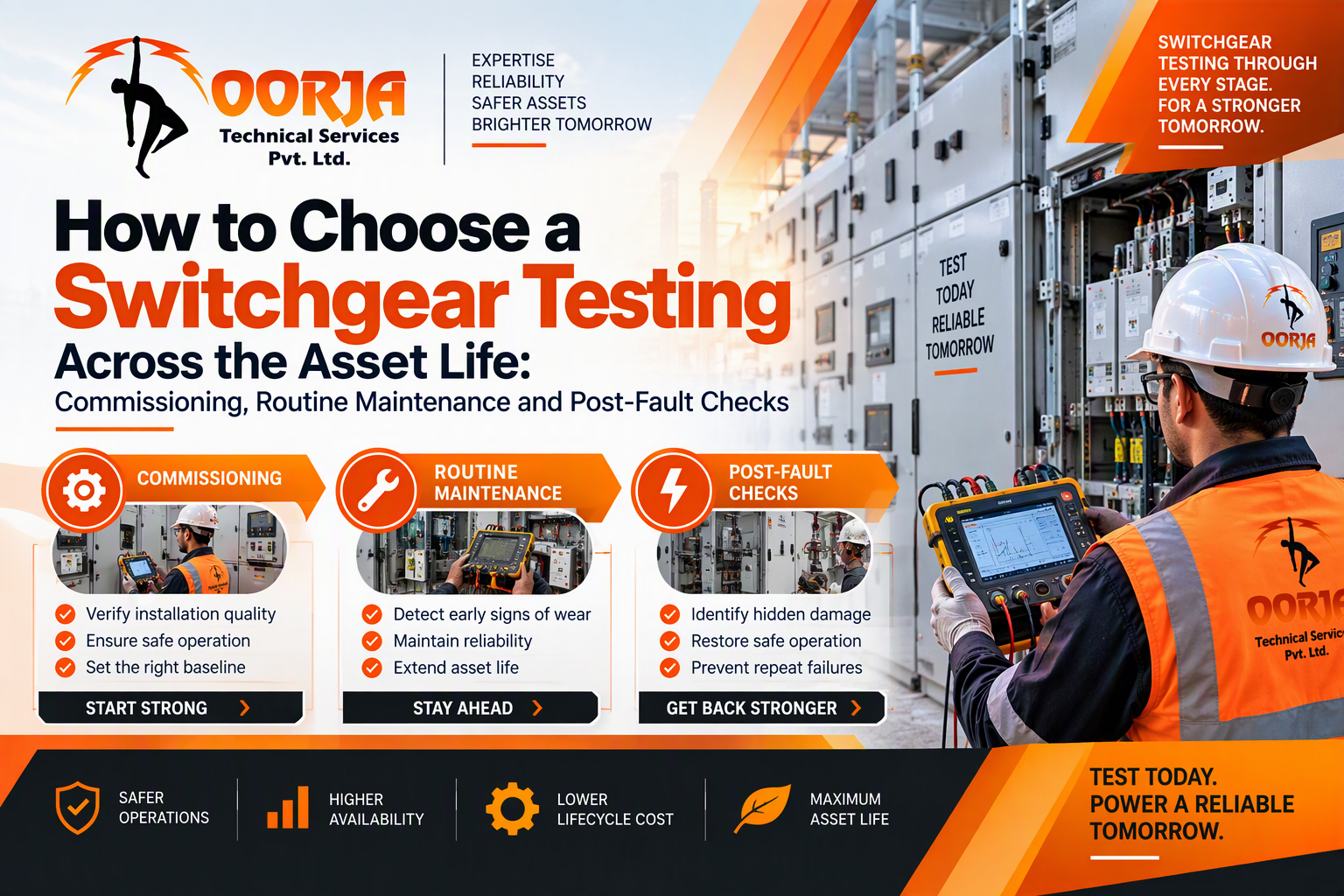
Switchgear Testing Across the Asset Life: Commissioning, Routine Maintenance and Post-Fault Checks

Switchgear is typically designed to serve for 25 to 30 years or more. Over that long life, it passes through very different stages: installation and commissioning, years of routine service, occasional fault events and eventually refurbishment or replacement. Each stage calls for a different kind of testing. Understanding them helps you plan a testing strategy that is both thorough and economical.
Stage 1: Commissioning Tests
When new switchgear is installed, commissioning tests prove that it was transported, assembled and connected correctly and that it is ready to take load. They also create the baseline readings against which all future tests are compared.
Typical commissioning tests include visual and mechanical checks, insulation resistance, contact resistance, breaker timing, CT and VT verification, protection relay testing, interlock checks and functional tests of the control scheme. Keep these records safe. They become the most valuable reference for the entire life of the panel.
Stage 2: Routine Testing of Higher Voltage Equipment
Once in service, high tension panels in industrial plants, substations and large commercial buildings need a regular routine. Specialised HT switchgear testing India work covers the breaker, busbars, isolators, instrument transformers and protection scheme, with extra attention to safety because of the energy levels involved.
The test interval depends on the environment and criticality. Clean, air-conditioned substations may be on a two- to three-year cycle, while dusty or humid locations and critical processes justify annual testing.
Stage 3: Routine Testing of Low Tension Boards
PCCs, MCCs, distribution boards and APFC panels are sometimes ignored because individual failures look small. In reality, they feed the motors, drives and process loads that make money for the plant. A structured LT switchgear maintenance and testing plan includes cleaning, tightening, thermal inspection, breaker and MCCB checks, protection setting verification and checks on capacitors and busbar supports.
Stage 4: Keeping Protection Coordinated
As the plant grows, protection settings must be revisited. New transformers, added feeders, captive generation and higher fault levels can all upset the coordination that was correct years ago. Scheduled relay and switchgear coordination testing checks that relays operate as intended and that upstream and downstream devices still grade properly, so a minor fault does not trip the whole substation.
Stage 5: Diagnostic Tests for Ageing Equipment
As switchgear approaches 15 to 20 years of service, deeper diagnostics become worthwhile. Contact wear, mechanism fatigue and insulation ageing become more likely. A focused switchgear contact resistance test service measures micro-ohm level resistance across breaker contacts and bus joints and helps decide whether contacts can continue in service, need refurbishment or should be replaced.
Other helpful diagnostics at this stage include partial discharge or ultrasonic surveys, detailed breaker analyser tests and gas quality checks for SF6 equipment.
Stage 6: Post-Fault Inspection
After any severe through-fault or a breaker operation at high fault current, the equipment should not simply be reclosed without checks. A post-fault inspection looks at contact condition, arc chutes, insulators, mechanism and enclosure, and repeats key electrical tests. Skipping this step is one of the most common reasons for repeat failures.
Building a Lifetime Testing Plan
A practical lifetime plan includes:
-
Commissioning tests and baseline records at installation
-
Routine preventive maintenance of switchgear at intervals suited to the environment
-
Thermal scans between shutdowns
-
Periodic protection verification and coordination review
-
Deeper diagnostics from mid-life onwards
-
Post-fault inspection whenever required
-
A refurbishment or replacement decision supported by trended data
Conclusion
Switchgear testing is not a single event but a lifelong relationship between the equipment and the people who maintain it. By matching the right test to each stage of the asset’s life and keeping good records, you get safer operation, fewer surprises and better value from every rupee spent on maintenance.
About Oorja Technical Services Pvt Ltd: Oorja Technical Services Pvt Ltd supports customers with commissioning, routine testing and maintenance of electrical equipment.
Contact: [email protected] | +91-9907759797 | oorjatechnical.in


