
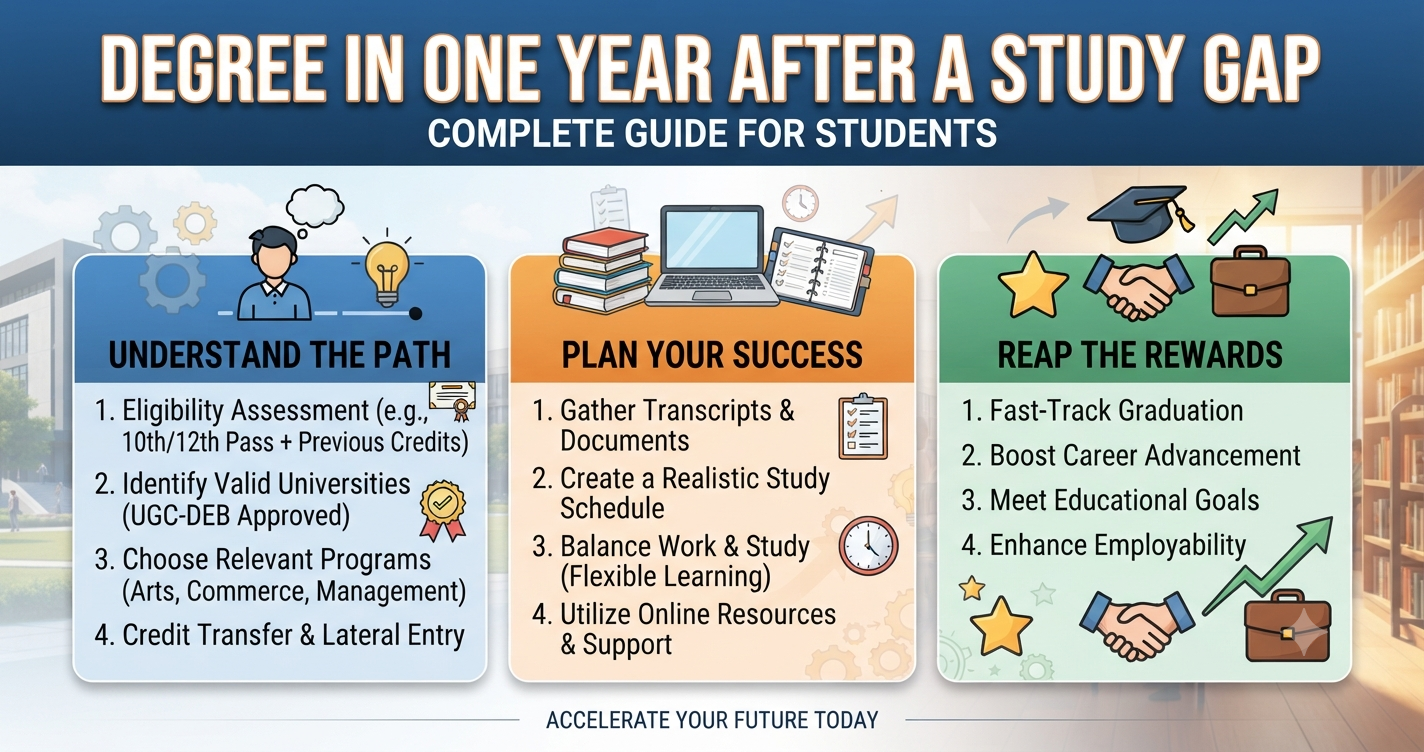
Degree in One Year After a Study Gap – Admission Guide 2026

Taking a break from education does not mean you have to give up on your graduation goals. Many students leave college because of financial challenges, family responsibilities, employment, health-related circumstances, or personal reasons. After a few years, they may decide to continue their studies to improve their career opportunities or qualify for higher education. For such learners, finding a suitable Degree in One Year option becomes an important consideration.
In India, students who discontinued their graduation can explore different academic pathways depending on their previous qualifications and completed semesters. Re-admission, credit transfer, online education, and distance learning may provide opportunities to resume higher education. Before selecting any programme, it is important to understand the admission requirements and university regulations.
Why Do Students Take a Study Gap?
A study gap can happen at different stages of academic life. Some students discontinue graduation after completing their first year, while others leave college before their final examinations.
Common reasons include:
-
Financial difficulties that make continuing regular college challenging.
-
Family responsibilities or personal circumstances.
-
Starting a full-time job to support financial needs.
-
Relocating to another city or state.
-
Changing career interests or educational plans.
-
Backlogs or unsuccessful attempts in previous examinations.
Regardless of the reason, students can investigate whether their earlier academic achievements remain eligible for recognition under the selected university's policies.
Can You Complete a Degree in One Year After a Study Gap?
Many students search online for a Degree in One Year because they want to finish their education without spending several additional years in college. However, the possibility of completing graduation within one year depends on the student's academic history and the applicable regulations.
An undergraduate degree generally follows a prescribed programme duration and credit requirements. A long study gap does not automatically reduce the required duration.
Students who have previously completed semesters may investigate credit transfer or re-admission facilities. These options depend on the university's academic rules, credit validity, programme structure, and acceptance of previous qualifications.
Students starting graduation from the beginning should consider the regular duration of an approved undergraduate programme rather than relying on unverified one-year degree advertisements.
Best Education Options After a Long Study Gap
Returning to education does not always require attending a traditional college every day. Depending on eligibility and course availability, students can consider several learning arrangements.
1. Re-Admission to an Undergraduate Programme
Students who previously discontinued BA, BCom, BBA, BCA, or another undergraduate programme can contact their former university about re-admission. The institution may review previous examination results, enrolment details, completed semesters, and applicable time limits.
2. Credit Transfer Facility
Credit transfer can help eligible students use previously earned academic credits when continuing education through an authorised institution. The accepting university determines whether the credits meet its course requirements.
The Academic Bank of Credits (ABC) supports credit accumulation, verification, and transfer between eligible higher education institutions. However, ABC does not independently award degrees.
3. Distance Education
Distance education provides an alternative for students who cannot attend regular classroom sessions. Learners can study through approved learning materials and follow the university's examination schedule.
4. Online Degree Programmes
Recognised online programmes offer digital learning resources, academic support, and flexible study arrangements. Working individuals and students with family responsibilities may find this mode convenient.
Students must verify that the university and specific programme are recognised for the relevant admission session.
Popular Graduation Courses to Consider
Students returning to education can explore different undergraduate subjects according to their academic background and career interests.
Bachelor of Arts (BA): Suitable for learners interested in humanities, languages, social sciences, and related subjects.
Bachelor of Commerce (BCom): An option for students interested in accounting, business, finance, and commerce-related careers.
Bachelor of Business Administration (BBA): Focuses on management, marketing, business operations, and organisational skills.
Bachelor of Computer Applications (BCA): Designed for students interested in computer applications, programming, and information technology.
Bachelor of Science (BSc): Provides subject-focused education in eligible science disciplines.
The admission requirements, practical components, and course duration vary by university.
Eligibility Criteria for Students Returning to College
Before applying for Graduation in One Year or another degree completion pathway, students should check the following requirements:
-
Completion of Class 12 or an equivalent qualification for undergraduate admission.
-
Previous college enrolment and semester records, where applicable.
-
Minimum marks or subject-specific requirements prescribed by the university.
-
Eligibility for credit transfer or re-admission.
-
Compliance with the programme's minimum and maximum duration.
-
Submission of required academic documents.
Students with incomplete graduation should contact the university's admission department to understand whether their previous academic progress can be considered.
Documents Required for Degree Completion Admission
Preparing documents in advance can make the admission process easier. Depending on the institution, applicants may need:
-
Class 10 and Class 12 mark sheets.
-
Previous graduation mark sheets.
-
Transfer certificate or migration certificate, if required.
-
Previous university enrolment details.
-
Government-approved identity proof.
-
Recent passport-size photographs.
-
Academic credit records, wherever applicable.
Candidates should submit accurate information because the university may verify previous academic records before approving admission.
Important UGC Guidelines Students Should Know
Students searching for a Degree in One Year should carefully review the applicable higher education regulations. UGC provides guidelines for recognised online and Open and Distance Learning programmes.
The Academic Bank of Credits also supports flexible academic pathways through credit recognition and transfer. Under applicable rules, credits may have a validity period of up to seven years, subject to the relevant institution and programme provisions.
How to Choose the Right University?
Selecting a suitable institution is an important step when restarting graduation after a study gap.
-
Verify university recognition through official sources.
-
Check the programme's approved duration and curriculum.
-
Understand the credit transfer and re-admission policy.
-
Compare tuition fees and examination charges.
-
Review study materials and academic support facilities.
-
Request official admission information before making payment.
Avoid institutions promising guaranteed graduation certificates without following the required academic process.
Conclusion
A study gap should not prevent anyone from pursuing higher education. Students who discontinued college can explore re-admission, credit transfer, distance learning, and recognised online degree programmes according to their academic eligibility.
Although the phrase Degree in One Year attracts many students, graduation duration must follow applicable university and regulatory requirements. Those interested in Graduation in One Year should first evaluate their previous academic records and understand the available legitimate pathways.
With proper guidance, careful university selection, and a clear educational plan, students can return to their studies and work towards completing their graduation successfully.
https://justpaste.it/distance-bca-course
https://janjaonline.mn.co/posts/ma-distance-education-admission-specializations-and-career-scope
https://penposh.com/blogs/28870/MCom-Distance-Education-Course-Benefits-Eligibility-Career-Scope
https://chodilinh.com/threads/msc-distance-education-admission-2027-eligibility-fees-process.692839/
https://www.mcmacademy.in/blog/doctorate-in-organizational-leadership/