
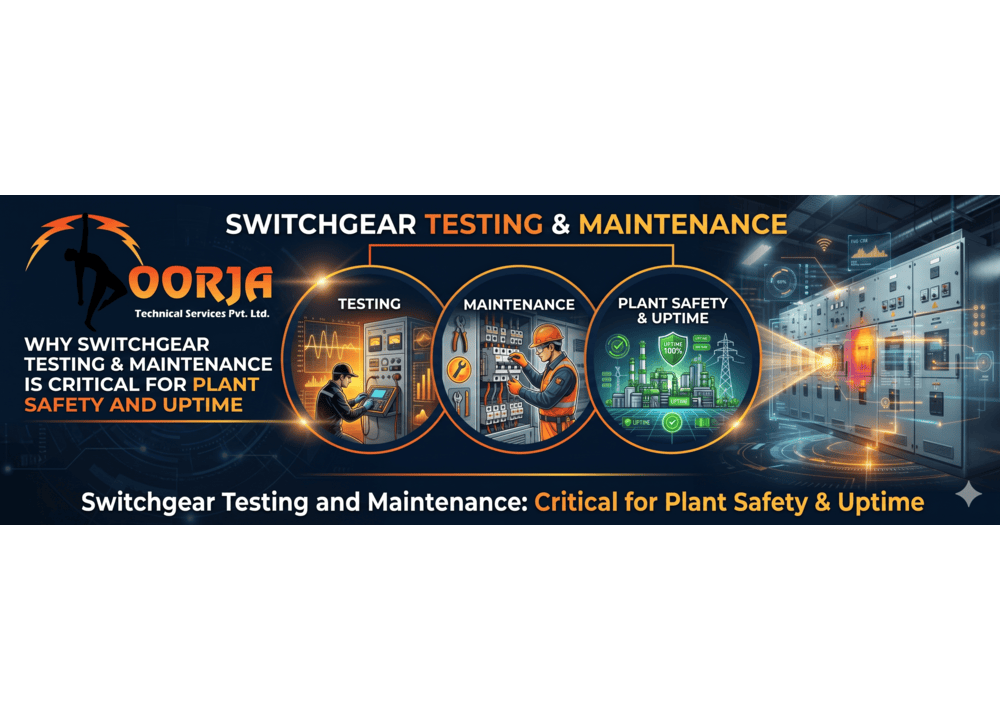
Why Switchgear Testing and Maintenance Is Critical for Plant Safety and Uptime

In every industrial plant, commercial building, hospital or data centre, switchgear quietly does the most important job in the electrical system: it controls, protects and isolates power. When it works, nobody notices. When it fails, the result can be an unplanned shutdown, equipment damage, arc flash injuries or even a fire. That is why professional switchgear testing services are no longer a “nice to have” but a basic part of responsible asset management.
In this article we explain what switchgear is, what typically goes wrong with it, and how a structured testing and maintenance programme protects both people and production.
What Is Switchgear and Why Does It Need Attention?
Switchgear is a combination of circuit breakers, isolators, busbars, fuses, protection relays, current and voltage transformers and control wiring, housed in a metal enclosure. Its job is to switch loads on and off, to carry normal current without overheating, and, most importantly, to interrupt fault current safely within milliseconds.
Because switchgear sits idle for long periods and then must operate instantly during a fault, hidden defects can stay undetected for years. Dust, moisture, loose connections, ageing insulation, worn mechanisms and drifted relay settings all build up silently. Only scheduled testing can reveal them before they turn into failures.
Common Problems Found in Ageing Switchgear
During field inspections, our engineers frequently come across issues such as:
-
Loose or oxidised bus joints and cable terminations that cause local heating
-
Reduced insulation strength due to moisture, dust and tracking
-
High contact resistance in breaker main contacts
-
Slow or sticky operating mechanisms, weak springs and dried-out lubrication
-
Faulty trip coils, closing coils and auxiliary contacts
-
Protection relays with wrong, outdated or untested settings
-
Gas leakage or reduced dielectric quality in SF6 equipment
None of these problems is obvious from outside the panel. All of them can be detected with the right tests.
Benefits of Periodic Testing and Maintenance
A planned programme delivers benefits that go far beyond “ticking the compliance box”:
-
Safety of people: Healthy switchgear reduces the risk of arc flash and electric shock during operation and maintenance.
-
Higher availability: Defects are corrected during planned shutdowns rather than during peak production.
-
Longer asset life: Early correction of heating, wear and insulation problems extends equipment life significantly.
-
Lower cost of ownership: Planned repair is always cheaper than emergency replacement and lost production.
-
Insurance and statutory compliance: Test records support audits, insurance requirements and electrical safety regulations.
HT and LT Switchgear: Different Needs, Same Discipline
High tension panels at 3.3 kV, 6.6 kV, 11 kV or 33 kV carry far greater energy and fault levels, so their failure consequences are more severe. Specialised HT switchgear testing India includes insulation tests, contact resistance, breaker timing, protection relay injection and, where applicable, high-voltage withstand testing, all performed by trained personnel with calibrated instruments.
Low tension boards such as PCCs, MCCs and APFC panels may look simpler, but they feed the actual process loads, so their reliability directly affects production. A proper LT switchgear maintenance and testing routine covers tightening of connections, cleaning, breaker and MCCB checks, thermal inspection and protection setting verification.
What a Typical Testing Programme Includes
-
Visual and mechanical inspection of the panel, mechanism and interlocks
-
Cleaning and torque checking of busbars and terminations
-
Insulation resistance measurement of busbars and breakers
-
Contact resistance measurement of breaker contacts and bus joints
-
Breaker operating time and trip-free checks
-
Protection relay secondary or primary injection testing
-
Thermographic scanning under load
-
Detailed test report with findings, trends and recommendations
Testing is normally guided by relevant IEC and IS standards and the equipment manufacturer’s recommendations.
Choosing the Right Service Partner
Electrical switchgear testing and servicing is specialist work. Look for a partner with calibrated test equipment, experienced and authorised engineers, clear reporting formats and the ability to work within your shutdown windows. Equally important is a team that can offer dependable switchgear maintenance services and not just testing, so that defects found are corrected in the same visit wherever possible.
Conclusion
Switchgear is too critical to be left to “run till it fails”. A regular schedule of inspection, testing and maintenance protects your people, your equipment and your production. If your switchgear has not been tested in the last 12 to 24 months, now is the right time to plan it.
About Oorja Technical Services Pvt Ltd: Oorja Technical Services Pvt Ltd provides electrical testing, commissioning and maintenance services for industry and commercial establishments across India.
Contact: [email protected] | +91-9907759797 | oorjatechnical.in


